
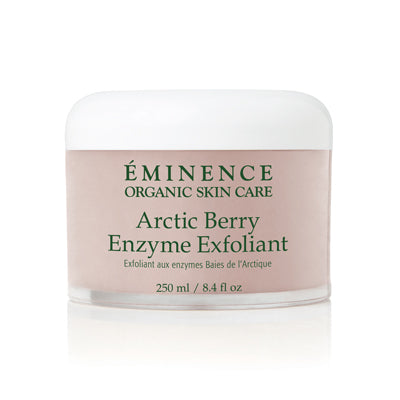

Eminence Organic Skin Care
Arctic Berry Enzyme Exfoliant

Arctic Berry Enzyme Exfoliant
Eminence Organic Skin Care
arctic-berry-enzyme-exfoliant
Exfoliation
9628205383973
Morning or Evening?
How often will you use this product?
Notes


Highlights
WHAT IS IT?
Enzyme exfoliant
FEATURES
Contains antioxidant-rich plants, essential vitamins, minerals and Omega 3 fatty acids
BEST FOR
All skin types
CHECKS
Does not contain parabens, sodium lauryl sulfate
Who Is It For?
Not Specified Likely Suitable For AdultsWhat Does It Help With?
Removes Dead Skin Prevents Visible Signs Of Aging Replenishes Moisture Restores Appearance Of ElasticityBudget
ProfessionalHow To Use
Which routine should it be used in?
Instructions:
Key Information


What Eminence Organic Skin Care Says
Product Description:
Our arctic berry enzyme exfoliant breaks down and removes dead skin to leave your skin feeling refreshed and new. A blend of four antioxidant-rich plants prevent the visible signs of aging, while essential vitamins, minerals and Omega 3 fatty acids replenish the skin's moisture and restore the appearance of elasticity.
About the Brand:
Ingredients Overview
Ingredients List
Rubus Chamaemorus (Cloudberry) Tea, Vaccinium Vitis Idaea (Lingonberry) Juice, Luffa Cylindrica Fruit Powder, Sodium Bicarbonate, Hydroxypropyl Starch Phosphate, Prunus Serotina (Wild Cherry) Bark Extract, Papain, Carbomer, Algin, 1,2-Hexanediol, Caprylyl Glycol, Disodium Lauroamphodiacetate, Vegetable Glycerin, Rubus Chamaemorus (Cloudberry) Seed Extract, Juniperus Communis (Juniper) Sprout Extract, Rhodiola Rosea (Arctic Roseroot) Root Extract, Spiraea Ulmaria (Arctic Meadowsweet) Extract, Xanthan Gum, Glyceryl Caprylate, Glyceryl Undecylenate, Hydrolyzed Hibiscus Exculentus Extract, Dextrin, Caramel, Azulene, Azelaic Acid, Salicylic Acid, Diatomaceous Earth, Vegetable Squalane, Ubiquinone (Coenzyme Q10), Tocopheryl Acetate (Vitamin E), Ascorbyl Palmitate (Vitamin C Ester), Niacinamide (Vitamin B3), Centella Asiatica (Gotu Kola) Meristem Cell Culture, Vaccinium Vitis Idaea (Lingonberry) Seed Oil.
Key Ingredients
Arctic Plants & Berries (cloudberry, arctic roseroot, arctic meadowsweet and juniper), Lingonberry Seed Oil, Hibiscus Extract, Natural Acids, Papaya Enzyme, Ground Wild Cherry Bark, Gotu-Kola Stem Cells
Ingredients Details
Algin
Common Name(s): Algin,cosmetic active,functional ingredient
CAS Number: N/a
DESCRIPTION
What It Does: Delivers characteristic cosmetic function at recommended use concentration.
Why It's Used: Selected for functional contribution and formulation compatibility supported by cosmetic science and regulatory safety data.
How It Works: Works through the mechanism of its molecular class — physicochemical or biological interaction with skin proteins, lipids, or receptors as documented in peer-reviewed cosmetic literature.
Typically Found In: Skin care formulations
TECHNICAL DETAILS
Primary Category: Active ingredient – cosmetic active
Secondary Functions: Skin conditioning
Application Areas:

Facial Skincare

Body Care
Hair Care
Beard Care
Color Cosmetics (Makeup)
Dietary/Oral Supplements
Typical Concentration Range: 0.1%–10%
SOURCING & ETHICS
Vegan Status: Conditional - supplier confirmation required
Halal Status: Unverified - supplier confirmation required
Source Notes: Commercially produced for cosmetic use. verify vegan/halal status with supplier. [audit 2026-07-29 rev2: the record's own source_notes does not assert a non-animal origin, or instructs the reader to verify with the supplier; "yes" asserts knowledge the record does not hold. determination requires shariah-panel sign-off.]
SKIN COMPATIBILITY
Irritancy Rating: 1/5 – very low
Comedogenicity Rating: 0/5 – non-comedogenic
Sensitivity Concerns: Well-tolerated by most skin types.
Safe for Sensitive Skin: Yes
SAFETY & COMPATIBILITY
Safety Profile: Good safety profile at recommended concentrations. ewg score: 1–2.
Works Well With: Standard skincare actives
Avoid Combining With: No known significant incompatibilities
SCIENTIFIC NOTE
Algin has an established safety and efficacy profile within the cosmetic regulatory framework at standard use concentrations.
Last Verified: 2026-03-12
Primary Sources: Cosing database,algin technical literature
Carbomer
Common Name(s): Carbopol,polyacrylic acid,carboxyvinyl polymer
DESCRIPTION
What It Does: Provides transparent gel textures and thickening at very low concentrations via ph-responsive swelling.
Why It's Used: The most widely used gel thickener – provides crystal-clear, stable gels at concentrations as low as 0.1-0.5% with ph-controlled viscosity.
How It Works: Highly crosslinked polyacrylic acid remains tightly coiled at acidic ph. neutralization with naoh or triethanolamine ionizes carboxylic groups causing electrostatic repulsion that unfolds and swells the polymer coils, dramatically increasing viscosity. concentration-dependent thickening.
Typically Found In: Gels,serums,emulsions,sunscreens
TECHNICAL DETAILS
Primary Category: Functional ingredient – polyacrylic acid thickener
Secondary Functions: Skin conditioning
Application Areas:
Facial Skincare
Body Care
Hair Care
Beard Care
Color Cosmetics (Makeup)
Dietary/Oral Supplements
Typical Concentration Range: 0.1%–2%
SOURCING & ETHICS
Vegan Status: Conditional - supplier confirmation required
Halal Status: Unverified - supplier confirmation required
Source Notes: Commercially produced for cosmetic use. verify vegan/halal status with supplier. [audit 2026-07-29 rev2: the record's own source_notes does not assert a non-animal origin, or instructs the reader to verify with the supplier; "yes" asserts knowledge the record does not hold. determination requires shariah-panel sign-off.]
SKIN COMPATIBILITY
Irritancy Rating: 1/5 – very low
Comedogenicity Rating: 0/5 – non-comedogenic
Sensitivity Concerns: Well-tolerated by most skin types.
Safe for Sensitive Skin: Yes
SAFETY & COMPATIBILITY
Safety Profile: Good safety profile at recommended concentrations. ewg score: 1–2.
Works Well With: Standard skincare actives
Avoid Combining With: No known significant incompatibilities
SCIENTIFIC NOTE
Carbomer's ph-responsive swelling mechanism provides an elegant formulation control tool: a neutralized gel can be liquefied by ph reduction (adding acid) and re-thickened by reneutralization. this reversible rheology control allows two-phase products that mix on application without the need for mechanical emulsification.
Last Verified: 2026-03-12
Primary Sources: Cosing database,cir safety assessment
Hydroxypropyl Starch Phosphate
Common Name(s): Natural or modified biopolymer thickener,rheology modifier,film-former
CAS Number: N/a
DESCRIPTION
What It Does: Builds aqueous viscosity through polymer chain entanglement above the overlap concentration, forms conditioning films on skin and hair, and stabilises suspensions through yield stress.
Why It's Used: Natural biopolymer thickeners provide elegant formulation sensory without the tight ph requirements of synthetic carbomers — preferred in shampoos and conditioners where broad ph tolerance and natural origin are both required.
How It Works: Polysaccharide chains above overlap concentration c* entangle forming a viscoelastic network — viscosity scales as c^4.7 above c*, providing steep concentration-viscosity dependence. chemical modification (hydroxypropyl, hydroxyethyl) increases water solubility and cold-processability of otherwise difficult-to-dissolve natural polysaccharides.
Typically Found In: Shampoos,conditioners,gels
TECHNICAL DETAILS
Primary Category: Active ingredient – cosmetic active
Secondary Functions: Skin conditioning
Application Areas:
Facial Skincare
Body Care
Hair Care
Beard Care
Color Cosmetics (Makeup)
Dietary/Oral Supplements
Typical Concentration Range: 0.1%–5%
SOURCING & ETHICS
Vegan Status: Conditional - supplier confirmation required
Halal Status: Unverified - supplier confirmation required
Source Notes: Commercially produced for cosmetic use. verify vegan/halal status with supplier. [audit 2026-07-29 rev2: the record's own source_notes does not assert a non-animal origin, or instructs the reader to verify with the supplier; "yes" asserts knowledge the record does not hold. determination requires shariah-panel sign-off.]
SKIN COMPATIBILITY
Irritancy Rating: 1/5 – very low
Comedogenicity Rating: 0/5 – non-comedogenic
Sensitivity Concerns: Well-tolerated by most skin types.
Safe for Sensitive Skin: Yes
SAFETY & COMPATIBILITY
Safety Profile: Good safety profile at recommended concentrations. ewg score: 1–2.
Works Well With: Standard skincare actives
Avoid Combining With: No known significant incompatibilities
SCIENTIFIC NOTE
Biopolymer thickeners are sensitive to electrolyte concentration — high salt levels screen polymer charge interactions reducing viscosity. formulation salt content must be accounted for when selecting polymer concentration for target viscosity.
Last Verified: 2026-03-12
Primary Sources: Cosing database,hydroxypropyl starch phosphate biopolymer thickener review
Papain
Common Name(s): Carica papaya enzyme,papaya protease
CAS Number: 9001-73-4
DESCRIPTION
What It Does: Gently digests dead keratin proteins for enzymatic exfoliation without acid irritation.
Why It's Used: Gentle enzymatic exfoliant for acid-sensitive skin types requiring exfoliation without ph-dependent aha/bha irritation.
How It Works: Cysteine protease specifically cleaves peptide bonds in keratin proteins at neutral ph, dissolving corneocyte protein bridges without requiring acidic ph. activity is ph- and temperature-dependent (optimal ph 6.5, 37°c). also gently solubilizes sebum plugs.
Typically Found In: Enzyme peels,gentle exfoliants,sensitive skin exfoliants,brightening masks
TECHNICAL DETAILS
Primary Category: Active ingredient – enzyme
Secondary Functions: Protein-specific exfoliation,neutral-ph keratolysis
Application Areas:
Facial Skincare
Body Care
Hair Care
Beard Care
Color Cosmetics (Makeup)
Dietary/Oral Supplements
Typical Concentration Range: 1%–10% (active enzyme)
SOURCING & ETHICS
Vegan Status: Yes – from carica papaya latex
Halal Status: Yes
Source Notes: Plant-derived (papaya, pineapple) or fermentation-derived.
SKIN COMPATIBILITY
Irritancy Rating: 2/5 – low to moderate; potential sensitization with repeated exposure
Comedogenicity Rating: 0/5 – non-comedogenic
Sensitivity Concerns: Patch test recommended; potential for enzymatic sensitization.
Safe for Sensitive Skin: Use with caution – potential sensitization
SAFETY & COMPATIBILITY
Safety Profile: Latex allergy cross-reactivity possible. avoid high concentrations on compromised skin.
Works Well With: Ahas (synergistic),hyaluronic acid,ceramides
Avoid Combining With: High concentrations on sensitive or compromised skin
SCIENTIFIC NOTE
Papain's specificity for peptide bonds at hydrophobic residues (leu, phe, val) in keratin provides preferential digestion of the abundant hydrophobic corneocyte proteins, causing selective dissolution of corneocyte protein bridges without disrupting the non-protein lipid matrix of the stratum corneum.
Last Verified: 2026-03-12
Primary Sources: Cosing database,cir safety assessment,enzyme exfoliant review literature