

Aqualogica
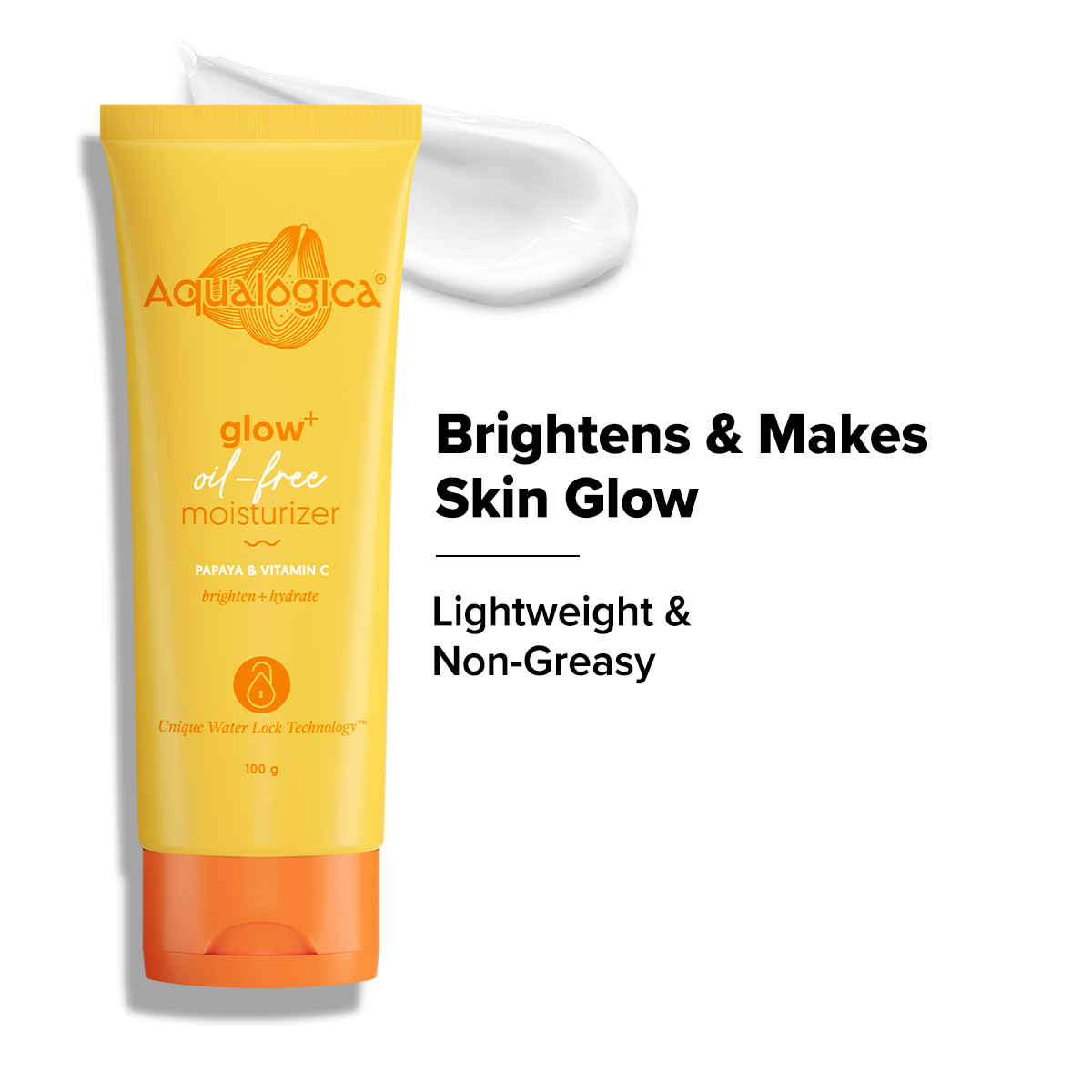
Aqualogica Glow+ Oil Free Moisturizer with Papaya & Vitamin C for Glowing Skin - 100 gm

Aqualogica Glow+ Oil Free Moisturizer with Papaya & Vitamin C for Glowing Skin - 100 gm
Aqualogica
aqualogica-glow-oil-free-moisturizer-with-papaya-vitamin-c-for-glowing-skin-100-gm
Moisturize
10084776935717
Morning or Evening?
How often will you use this product?
Notes


Highlights
WHAT IS IT?
Oil Free Moisturizer with 4 key ingredients
FEATURES
Oil-free, Contains Papaya, Vitamin C, Hyaluronic Acid, and Glycerin for hydration and nourishment, Controls excessive oil production, Fast-absorbing, Non-sticky, Light and cool on skin, Slows down aging, Improves skin texture, Enhances skin glow
BEST FOR
oily
CHECKS
Does not contain oil
Who Is It For?
Not Explicitly Stated; Likely Adult Women And MenWhat Does It Help With?
Hydration Oil Control Anti-aging Improving Skin Texture Enhancing Skin GlowBudget
Mid-range ($30-$75)How To Use
Which routine should it be used in?
Instructions:
Key Information


What Aqualogica Says
Product Description:
Your oily skin can be thirsty too! Enliven it with Glow+ Oil-Free Moisturizer. A perfect concoction of Papaya, Vitamin C, Hyaluronic Acid, and Glycerin, this oil-free moisturizer makes your skin soft, supple, and deeply nourished. Its hardworking ingredients keep your skin hydrated throughout the day and control excessive oil production. With regular use, it slows down aging, improves the skin texture, and enhances its glow. The moisturizer with its fast-absorbing and non-sticky formula, feels so light and cool on your skin, that you’d never forget to moisturize!
About the Brand:
Ingredients Overview
Ingredients List
Aqua, Glycerin, Caprylic/Capric Triglyceride, Isopropyl Myristate, Glyceryl Stearate Citrate, Pentaerythrityl Distearate, Phenoxyethanol, Behenyl Alcohol, Papaya Fruit Extract, Ammonium Polyacryloyldimethyl Taurate, Vitamin C, Ethylhexylglycerin, Hyaluronic Acid Crosspolymer, Titanium Dioxide, Acrylates/C10-30 Alkyl Acrylate Crosspolymer, Isopropyl Palmitate, Glyceryl Glucoside, Trisodium Ethylenediamine Disuccinate, Aluminum Hydroxide, Lauric Acid, Pentylene Glycol, Sodium Hydroxide, IFRA Certified Allergen Free Fragrance
Key Ingredients
Papaya, Vitamin C, Hyaluronic Acid, Glycerin
Ingredients Details
Acrylates/c10-30 Alkyl Acrylate Crosspolymer
Common Name(s): Acrylates/c10-30 alkyl acrylate crosspolymer
DESCRIPTION
What It Does: Delivers targeted skin-conditioning or bioactive benefits through a specific mechanism of action suited to the formulation's intended purpose.
Why It's Used: Specialty actives address specific skin concerns through targeted molecular mechanisms, providing efficacy beyond what base formulation ingredients alone can achieve.
How It Works: The bioactive compound interacts with specific molecular targets in skin cells or the extracellular matrix — enzymes, receptors, structural proteins, or signaling molecules — triggering beneficial biological responses.
Typically Found In: Serums,treatments,moisturizers,specialty products
TECHNICAL DETAILS
Primary Category: Specialty actives
Secondary Functions: Skin-conditioning,anti-aging
Application Areas:

Facial Skincare

Body Care
Hair Care
Beard Care
Color Cosmetics (Makeup)
Dietary/Oral Supplements
Typical Concentration Range: 0.01–5%
SOURCING & ETHICS
Vegan Status: Conditional - supplier confirmation required
Halal Status: Unverified - supplier confirmation required
Source Notes: Specialty active ingredient; check individual sourcing for vegan status. [audit 2026-07-29 rev2: the record's own source_notes does not assert a non-animal origin, or instructs the reader to verify with the supplier; "yes" asserts knowledge the record does not hold. determination requires shariah-panel sign-off.]
SKIN COMPATIBILITY
Irritancy Rating: 1
Comedogenicity Rating: 0
Sensitivity Concerns: Low sensitization potential at recommended use concentrations.
Safe for Sensitive Skin: Yes
SAFETY & COMPATIBILITY
Safety Profile: Well-characterized cosmetic ingredient with established safety profile. generally non-irritating at typical use concentrations. suitable for leave-on and rinse-off cosmetics.
Works Well With: Niacinamide,hyaluronic acid,vitamin c,peptides
Avoid Combining With: Incompatible with oxidizing agents; check ph stability
SCIENTIFIC NOTE
Specialty actives typically work through enzyme inhibition (e.g., tyrosinase inhibition for brightening, mmp inhibition for anti-aging), receptor activation (e.g., retinoid receptors, ppar-γ for barrier genes), or transcription factor modulation (e.g., nrf2 for antioxidant gene upregulation). structure-activity relationships determine potency and selectivity.
Last Verified: 2025-01-15
Primary Sources: Cosing eu database; pcpc cosmetic ingredient safety reviews; ingredient-specific safety and efficacy literature
Aluminum Hydroxide
Common Name(s): Aluminum hydroxide,cosmetic active,functional ingredient
CAS Number: N/a
DESCRIPTION
What It Does: Delivers characteristic cosmetic function at recommended use concentration.
Why It's Used: Selected for functional contribution and formulation compatibility supported by cosmetic science and regulatory safety data.
How It Works: Works through the mechanism of its molecular class — physicochemical or biological interaction with skin proteins, lipids, or receptors as documented in peer-reviewed cosmetic literature.
Typically Found In: Skin care formulations
TECHNICAL DETAILS
Primary Category: Active ingredient – cosmetic active
Secondary Functions: Skin conditioning
Application Areas:
Facial Skincare
Body Care
Hair Care
Beard Care
Color Cosmetics (Makeup)
Dietary/Oral Supplements
Typical Concentration Range: 0.1%–10%
SOURCING & ETHICS
Vegan Status: Conditional - supplier confirmation required
Halal Status: Unverified - supplier confirmation required
Source Notes: Commercially produced for cosmetic use. verify vegan/halal status with supplier. [audit 2026-07-29 rev2: the record's own source_notes does not assert a non-animal origin, or instructs the reader to verify with the supplier; "yes" asserts knowledge the record does not hold. determination requires shariah-panel sign-off.]
SKIN COMPATIBILITY
Irritancy Rating: 1/5 – very low
Comedogenicity Rating: 0/5 – non-comedogenic
Sensitivity Concerns: Well-tolerated by most skin types.
Safe for Sensitive Skin: Yes
SAFETY & COMPATIBILITY
Safety Profile: Good safety profile at recommended concentrations. ewg score: 1–2.
Works Well With: Standard skincare actives
Avoid Combining With: No known significant incompatibilities
SCIENTIFIC NOTE
Aluminum hydroxide has an established safety and efficacy profile within the cosmetic regulatory framework at standard use concentrations.
Last Verified: 2026-03-12
Primary Sources: Cosing database,aluminum hydroxide technical literature
Ammonium Polyacryloyldimethyl Taurate
Common Name(s): Carbomer/acrylate crosspolymer,highly efficient gel former,rheology modifier
CAS Number: N/a
DESCRIPTION
What It Does: Forms transparent to translucent high-viscosity gels at very low concentration, suspends particles and pigments against sedimentation through yield stress, and provides the elegant shear-thinning texture of premium gel serums.
Why It's Used: The most efficient aqueous thickener available — achieving gel viscosity at 0.1% that requires 3–5% of xanthan gum or 2% of cellulose thickeners, enabling clean-label lightweight formulations with high active loading.
How It Works: At ph <4: –cooh groups protonated, polymer coiled compact, low viscosity. neutralisation with naoh/tea deprotonates –cooh to –coo⁻; like-charge repulsion expands polymer coil 100–1000×. above overlap concentration c* (~0.1%), expanded coils entangle forming viscoelastic gel network providing high zero-shear viscosity and shear-thinning.
Typically Found In: Gel serums,transparent toners,suspension systems
TECHNICAL DETAILS
Primary Category: Active ingredient – cosmetic active
Secondary Functions: Skin conditioning
Application Areas:
Facial Skincare
Body Care
Hair Care
Beard Care
Color Cosmetics (Makeup)
Dietary/Oral Supplements
Typical Concentration Range: 0.1%–2%
SOURCING & ETHICS
Vegan Status: Conditional - feedstock declaration required
Halal Status: Unverified - feedstock declaration required (plant, animal and petrochemical routes all exist)
Source Notes: Commercially produced for cosmetic use. verify vegan/halal status with supplier. [audit 2026-07-29 rev2: origin-dependent: the same inci exists in plant, animal and petrochemical versions and the name does not discriminate. determination requires shariah-panel sign-off.]
SKIN COMPATIBILITY
Irritancy Rating: 1/5 – very low
Comedogenicity Rating: 0/5 – non-comedogenic
Sensitivity Concerns: Well-tolerated by most skin types.
Safe for Sensitive Skin: Yes
SAFETY & COMPATIBILITY
Safety Profile: Good safety profile at recommended concentrations. ewg score: 1–2.
Works Well With: Standard skincare actives
Avoid Combining With: No known significant incompatibilities
SCIENTIFIC NOTE
Carbomer is edta-sensitive — divalent cation contamination (ca²⁺, mg²⁺ from hard water) can collapse the electrostatic gel network. including edta or citric acid chelation in carbomer-gelled formulas is standard practice to maintain gel integrity.
Last Verified: 2026-03-12
Primary Sources: Cosing database,carbomer polyacrylate gel mechanism review
Behenyl Alcohol
Common Name(s): Behenyl alcohol,inci ingredient,cosmetic active
CAS Number: N/a
DESCRIPTION
What It Does: Provides documented cosmetic activity from behenyl alcohol.
Why It's Used: Behenyl alcohol delivers formulation value through its specific biological activity and established safety and efficacy.
How It Works: Source: behenyl alcohol. mechanism: documented in cosmetic literature. safety: cosing-reviewed. standard cosmetic use concentrations.
Typically Found In: Skin care formulations,active products
TECHNICAL DETAILS
Primary Category: Active ingredient – antioxidant
Secondary Functions: Free radical scavenging,anti-aging
Application Areas:
Facial Skincare
Body Care
Hair Care
Beard Care
Color Cosmetics (Makeup)
Dietary/Oral Supplements
Typical Concentration Range: 0.1%–5%
SOURCING & ETHICS
Vegan Status: Yes - standard ethanol routes are non-animal; confirm denaturant origin
Halal Status: Conditional - ethanol production route and residual concentration; jurisdiction-dependent, refer to certifier stance
Source Notes: Plant-derived extract or synthetic. [audit 2026-07-29 rev2: ethanol pathway; determination depends on route, on whether the plant also produces beverage alcohol, and on residual concentration. determination requires shariah-panel sign-off.]
SKIN COMPATIBILITY
Irritancy Rating: 1/5 – very low
Comedogenicity Rating: 0/5 – non-comedogenic
Sensitivity Concerns: Non-irritating; well-tolerated.
Safe for Sensitive Skin: Yes
SAFETY & COMPATIBILITY
Safety Profile: Excellent safety profile. ewg score: 1.
Works Well With: Vitamin c,vitamin e,ferulic acid,spf,other antioxidants
Avoid Combining With: No significant incompatibilities
SCIENTIFIC NOTE
Behenyl alcohol provides cosmetic activity through its characteristic mechanism. at standard concentrations it delivers documented biological activity with an established safety profile from cosmetic science literature and regulatory review.
Last Verified: 2026-03-12
Primary Sources: Cosing database,behenyl alcohol technical literature