

Aqualogica
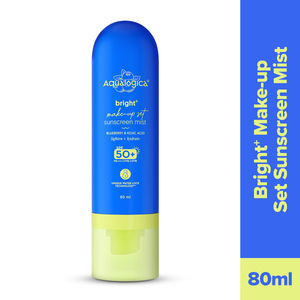
Aqualogica Bright+ Makeup-Set Sunscreen Mist - 80 ml

Aqualogica Bright+ Makeup-Set Sunscreen Mist - 80 ml
Aqualogica
aqualogica-bright-makeup-set-sunscreen-mist-80-ml
Suncare
10084941463845
Morning or Evening?
How often will you use this product?
Notes


Highlights
WHAT IS IT?
Makeup-Set Sunscreen Mist with Blueberries, Kojic Acid, and Hyaluronic Acid
FEATURES
Double-duty action as sunscreen and makeup setting spray, SPF 50+ PA++++ protection, fights UV rays, sweat-proof, brightens skin, evens skin tone, hydrates skin, no white cast, dreamy floral fragrance
BEST FOR
sensitive
CHECKS
Does not let your makeup melt, sweat-proof, no white cast
Who Is It For?
Unisex All AdultsWhat Does It Help With?
Brightening Skin Even Skin Tone Hydration Uv Protection Makeup SettingBudget
Mid-range ($30-$75)How To Use
Which routine should it be used in?
Instructions:
Key Information


What Aqualogica Says
Product Description:
Iconic Collab Alert! Your sunscreen & makeup are now besties. Introducing Aqualogica Bright+ Makeup Set Sunscreen Mist that hustles 2x harder and doubles down as a sunscreen and makeup setting spray. Because who has time for 347 steps in their routine? Like, for real! All hail to its double-duty action, this fine face mist offers SPF 50+ PA++++, fights UV rays & doesn't let your makeup melt like an ice cream. Thanks to its hyping team, the Blueberries in the mist will brighten your skin, Kojic Acid will even out your skin tone, and Hyaluronic Acid will drench your skin in hydration. Definitely a mainstay in your routine! Think of this - you're prepping to slay the day, doing your full face, vibing to your makeup playlist and uh-oh, you realize you’ve skipped sunscreen. Don't sweat it (literally) cause this sweat-proof mist has you covered! So go ahead spritz & repeat it throughout the day without the fear of white cast. Aura points to its dreamy floral fragrance! And it's wrapped in packaging that gives off clean girl energy. Because queens deserve sunscreens that slay as hard as they do.
About the Brand:
Ingredients Overview
Ingredients List
Aqua, Ethyl Alcohol, Methoxycinnamidopropyl Hydroxysultaine, Terephthalylidene, Dicamphor Sulfonic Acid, Methylpropanediol, Propanediol, Phenylbenzimidazole Sulfonic Acid, Triethanolamine, Phenoxyethanol (and) Ethylhexylglycerin, Oleth 3, Glycerin (and) Glyceryl Glucoside, Hydroxyapatite, Methylene Bis-Benzotriazolyl Tetramethylbutylphenol (and) Aqua (and) Decyl Glucoside (and) Propylene Glycol (and) Xanthan Gum, Benzophenone-4, Tocopheryl Acetate, Vaccinium Angustifolium Fruit Extract (Blueberry extract), Kojic Acid, Fragrance, Sodium Hyaluronate
Key Ingredients
Blueberries,Kojic Acid,Hyaluronic Acid
Ingredients Details
Benzophenone-4
Common Name(s): Benzophenone-4
DESCRIPTION
What It Does: Absorbs or reflects uv radiation, preventing uv-induced dna damage, photo-oxidative stress, and premature skin aging.
Why It's Used: Uv filters are the active ingredients in sun protection — without them, formulations cannot make spf claims or prevent solar-induced skin damage.
How It Works: The uv-absorbing chromophore undergoes photoexcitation by uv photons, then dissipates the absorbed energy through thermal relaxation (chemical filters) or photon scattering/reflection (physical filters), preventing photon penetration to skin cells.
Typically Found In: Sunscreens,moisturizers with spf,foundations with spf
TECHNICAL DETAILS
Primary Category: Uv filters
Secondary Functions: Skin-protecting
Application Areas:

Facial Skincare

Body Care
Hair Care
Beard Care
Color Cosmetics (Makeup)
Dietary/Oral Supplements
Typical Concentration Range: 0.5–25% (within regulatory limits)
SOURCING & ETHICS
Vegan Status: Yes
Halal Status: Yes
Source Notes: Synthetic uv filter; no animal components.
SKIN COMPATIBILITY
Irritancy Rating: 1
Comedogenicity Rating: 0
Sensitivity Concerns: Contact allergy to uv filters occurs in approximately 1–3% of the general population; patch testing recommended for those with known photosensitivity.
Safe for Sensitive Skin: Yes
SAFETY & COMPATIBILITY
Safety Profile: Regulatory approval required per market (eu annex vi, fda otc monograph, etc.). generally non-irritating at approved concentrations.
Works Well With: Other uv filters,antioxidants,emollients
Avoid Combining With: Incompatible filter combinations (photodegradation); check regulatory approvals per region
SCIENTIFIC NOTE
Uv filters operate through two mechanisms: organic/chemical filters absorb uv photons through electronic excitation (π→π* transitions in conjugated systems), then dissipate energy via thermal relaxation; inorganic/physical filters (tio2, zno) scatter and reflect photons through mie scattering (particle size 50–300 nm) and band gap absorption. spf is measured in vivo (iso 24444) as the ratio of minimal erythema doses with and without sunscreen.
Last Verified: 2025-01-15
Primary Sources: Cosing eu database; pcpc cosmetic ingredient safety reviews; eu cosmetics regulation annex vi; iso 24444 (in vivo spf testing)
Fragrance
Common Name(s): Fragrance ingredient,eu allergen or aromatic component,olfactory/flavour
CAS Number: N/a
DESCRIPTION
What It Does: Provides the complete fragrance profile contributing to product sensory experience and consumer appeal.
Why It's Used: Fragrance is a major consumer purchase driver — up to 70% of consumers make purchasing decisions partially based on product scent.
How It Works: Fragrance blends interact with olfactory receptors providing the sensory profile — complex mixtures activate multiple receptor types for rich, multidimensional scent experiences.
Typically Found In: All fragrance products
TECHNICAL DETAILS
Primary Category: Active ingredient – cosmetic active
Secondary Functions: Skin conditioning
Application Areas:
Facial Skincare
Body Care
Hair Care
Beard Care
Color Cosmetics (Makeup)
Dietary/Oral Supplements
Typical Concentration Range: Standard use levels
SOURCING & ETHICS
Vegan Status: Conditional - supplier confirmation required
Halal Status: Unverified - supplier confirmation required
Source Notes: Commercially produced for cosmetic use. verify vegan/halal status with supplier. [audit 2026-07-29 rev2: the record's own source_notes does not assert a non-animal origin, or instructs the reader to verify with the supplier; "yes" asserts knowledge the record does not hold. determination requires shariah-panel sign-off.]
SKIN COMPATIBILITY
Irritancy Rating: 1/5 – very low
Comedogenicity Rating: 0/5 – non-comedogenic
Sensitivity Concerns: Well-tolerated by most skin types.
Safe for Sensitive Skin: Yes
SAFETY & COMPATIBILITY
Safety Profile: Good safety profile at recommended concentrations. ewg score: 1–2.
Works Well With: Standard skincare actives
Avoid Combining With: No known significant incompatibilities
SCIENTIFIC NOTE
Ifra guidelines set usage limits for fragrance ingredients based on skin sensitisation and phototoxicity assessment for each application category.
Last Verified: 2026-03-12
Primary Sources: Eu regulation 1223/2009 annex iii,ifra standards,fragrance allergen declaration requirements
Hydroxyapatite
Common Name(s): Hydroxyapatite,cosmetic active,functional ingredient
CAS Number: N/a
DESCRIPTION
What It Does: Delivers characteristic cosmetic function at recommended use concentration.
Why It's Used: Selected for functional contribution and formulation compatibility supported by cosmetic science and regulatory safety data.
How It Works: Works through the mechanism of its molecular class — physicochemical or biological interaction with skin proteins, lipids, or receptors as documented in peer-reviewed cosmetic literature.
Typically Found In: Skin care formulations
TECHNICAL DETAILS
Primary Category: Active ingredient – cosmetic active
Secondary Functions: Skin conditioning
Application Areas:
Facial Skincare
Body Care
Hair Care
Beard Care
Color Cosmetics (Makeup)
Dietary/Oral Supplements
Typical Concentration Range: 0.1%–10%
SOURCING & ETHICS
Vegan Status: Conditional - supplier confirmation required
Halal Status: Unverified - supplier confirmation required
Source Notes: Commercially produced for cosmetic use. verify vegan/halal status with supplier. [audit 2026-07-29 rev2: the record's own source_notes does not assert a non-animal origin, or instructs the reader to verify with the supplier; "yes" asserts knowledge the record does not hold. determination requires shariah-panel sign-off.]
SKIN COMPATIBILITY
Irritancy Rating: 1/5 – very low
Comedogenicity Rating: 0/5 – non-comedogenic
Sensitivity Concerns: Well-tolerated by most skin types.
Safe for Sensitive Skin: Yes
SAFETY & COMPATIBILITY
Safety Profile: Good safety profile at recommended concentrations. ewg score: 1–2.
Works Well With: Standard skincare actives
Avoid Combining With: No known significant incompatibilities
SCIENTIFIC NOTE
Hydroxyapatite has an established safety and efficacy profile within the cosmetic regulatory framework at standard use concentrations.
Last Verified: 2026-03-12
Primary Sources: Cosing database,hydroxyapatite technical literature
Kojic Acid
Common Name(s): 5-hydroxy-2-(hydroxymethyl)-4-pyranone,koji acid
CAS Number: 501-30-4
DESCRIPTION
What It Does: Provides potent copper-chelating tyrosinase inhibition for effective hyperpigmentation treatment.
Why It's Used: One of the most effective brightening agents — kojic acid's copper chelation directly blocks the tyrosinase active site providing stronger brightening than most naturally-derived alternatives.
How It Works: Chelates copper in the tyrosinase active site via the 3-hydroxy-4-pyranone chelating group (ic50 ~5μg/ml). without copper cofactor, tyrosinase cannot oxidise tyrosine to dopa or dopa to dopaquinone. inhibits both hydroxylation steps in eumelanin synthesis pathway.
Typically Found In: Brightening serums,hyperpigmentation treatments,anti-spot products
TECHNICAL DETAILS
Primary Category: Active ingredient – fungal brightening agent
Secondary Functions: Melanin inhibition,hyperpigmentation reduction
Application Areas:
Facial Skincare
Body Care
Hair Care
Beard Care
Color Cosmetics (Makeup)
Dietary/Oral Supplements
Typical Concentration Range: 0.5%–2%
SOURCING & ETHICS
Vegan Status: Yes – from aspergillus oryzae or acetobacter fermentation
Halal Status: Yes
Source Notes: Synthetic or plant-derived.
SKIN COMPATIBILITY
Irritancy Rating: 1/5 – very low
Comedogenicity Rating: 0/5 – non-comedogenic
Sensitivity Concerns: Non-irritating; well-tolerated.
Safe for Sensitive Skin: Yes
SAFETY & COMPATIBILITY
Safety Profile: Eu annex iii regulated: max 1% in face products. sensitiser potential — patch test for sensitive skin. photosensitive in formulation — requires stabilisation.
Works Well With: Niacinamide,vitamin c,alpha-arbutin,tranexamic acid,spf
Avoid Combining With: No significant incompatibilities
SCIENTIFIC NOTE
Kojic acid's copper chelation mechanism provides an unusually direct enzyme inhibition: rather than competing with tyrosine substrate (competitive inhibitor) or altering enzyme conformation (allosteric inhibitor), kojic acid simply removes the copper cofactor that is essential for tyrosinase catalytic activity — a metal-chelation mechanism that provides near-complete enzyme inhibition regardless of substrate concentration.
Last Verified: ##########
Primary Sources: Cosing database,eu annex iii,cir safety assessment