
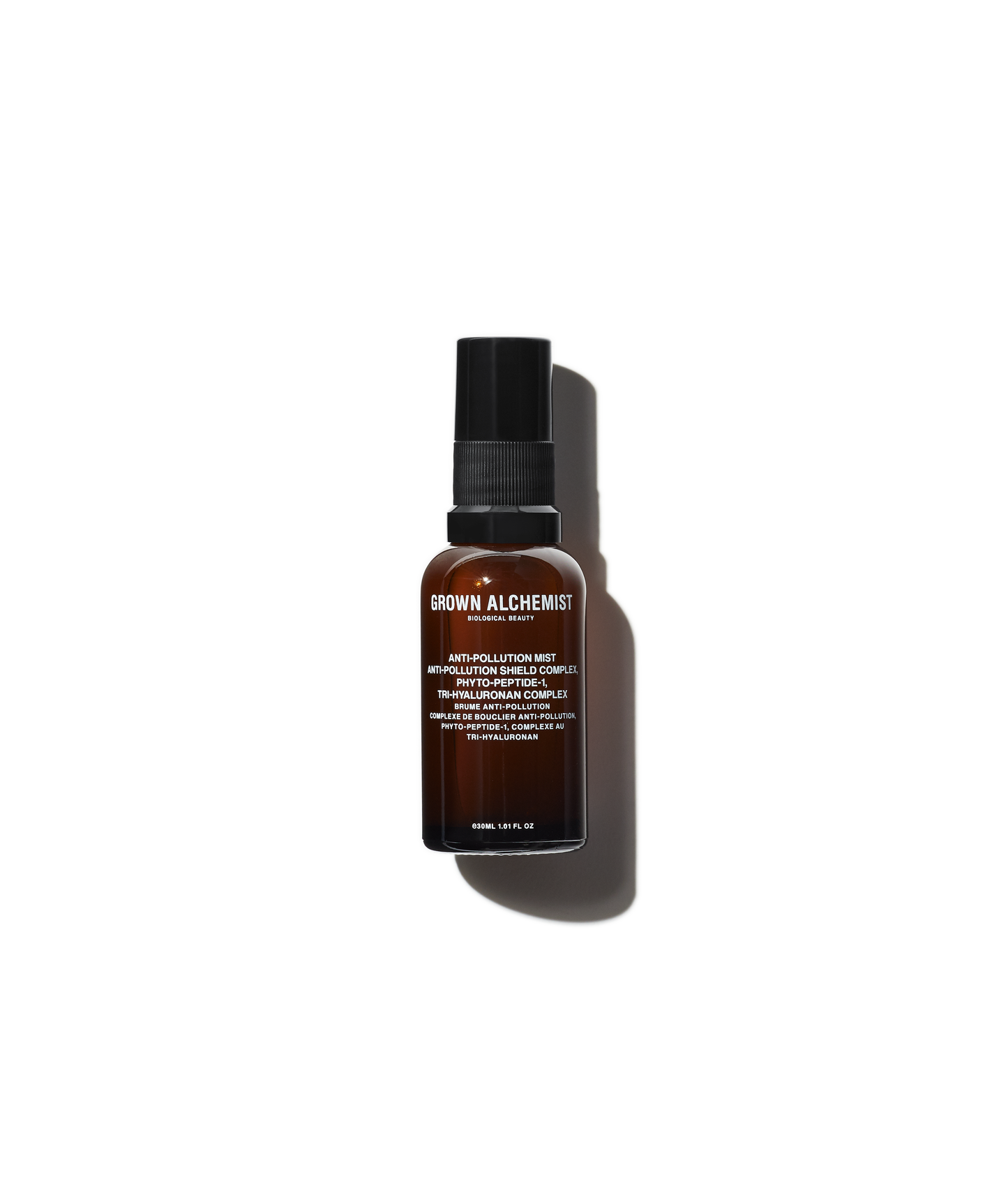

Grown Alchemist
Anti-Pollution Mist

Anti-Pollution Mist
Grown Alchemist
anti-pollution-mist
Tone
9784770855205
Morning or Evening?
How often will you use this product?
Notes


Highlights
WHAT IS IT?
Protective facial mist with three key complexes
FEATURES
Protects against digital light emissions and environmental aggressors, provides intensive hydration, reduces fine lines and wrinkles
BEST FOR
normal
CHECKS
Clean beauty formulation
Who Is It For?
Adults Of All GendersWhat Does It Help With?
Protection Against Pollution Damage Pigmentation Age Spots Skin Hydration Fine Lines And WrinklesBudget
Affordable (under $30)How To Use
Which routine should it be used in?
Instructions:
Key Information


What Grown Alchemist Says
Product Description:
A protective facial mist with Anti-Pollution Shield Complex, Phyto-Peptide-1, and Tri-Hyaluronan Complex that protects against digital light emissions and environmental aggressors while providing intensive hydration.
About the Brand:
Ingredients Overview
Ingredients List
Aqua/Water/Eau, Aloe Barbadensis Leaf Extract, Helianthus Annuus (Sunflower/Tournesol) Seed Oil, Lecithin, Polyglyceryl-3 Disostearate (*Plant/Plante), Vitis Vinifera (Grapeseed/Pépins de Raisins) Seed Oil, Ficus Carica (Fig/Figue) Fruit Extract, Propanediol (*Plant/Plante), Buddleja Officinalis Flower Extract, Echinacea Purpurea Extract (*Plant/Plante), (Anti-Pollution Complex/Complexe Anti-Pollution) (*Plant/Plante), Squalane (*Plant/Plante), Sodium Hyaluronate (*Plant/Plante), Oligopeptide-1 (Phyto-Peptide-1) (*Plant/Plante), Benzyl Alcohol, Dehydroacetic Acid, Heptyl Glucoside (*Plant/Plante), Rosa Damascena (Rose) Flower Oil, Citrus Nobilis (Mandarin/Mandarine) Peel Oil, Pelargonium Graveolens (Geranium/Géranium) Flower Oil, Glycerin (*Plant/Plante), Glyceryl Stearate (*Plant/Plante), Citral (*Plant/Plante), Citronolellol (*Plant/Plante), Eugenol (*Plant/Plante), Farnesol (*Plant/Plante), Geraniol (*Plant/Plante), Limonene (*Plant/Plante), Linalool (*Plant/Plante). (*Plant Derived/Dérivé des Plantes).
Key Ingredients
Buddleja Flower Extract, Echinacea Extract, Phyto-Peptide-1, Tri-Hyaluronan Complex
Ingredients Details
Aloe Barbadensis Leaf Extract
Common Name(s): Aloe barbadensis leaf extract,botanical extract,phytochemical active
CAS Number: N/a
DESCRIPTION
What It Does: Provides antioxidant protection from reactive oxygen species, reduces inflammatory cytokine production in skin, and conditions skin surface through the plant's secondary metabolite complex.
Why It's Used: Chosen for its natural origin narrative, traditional use heritage, and multi-functional phytochemical profile that supports several concurrent skin care claims from one ingredient.
How It Works: Polyphenols, terpenoids, and alkaloids in the extract scavenge ros via hydrogen atom transfer, inhibit nf-kb or cox-2 inflammatory pathways, and interact with skin surface proteins for conditioning.
Typically Found In: Botanical skin care,natural products
TECHNICAL DETAILS
Primary Category: Active ingredient – antioxidant
Secondary Functions: Free radical scavenging,anti-aging
Application Areas:

Facial Skincare
Body Care

Hair Care
Beard Care
Color Cosmetics (Makeup)
Dietary/Oral Supplements
Typical Concentration Range: 0.1%–10%
SOURCING & ETHICS
Vegan Status: Yes
Halal Status: Yes
Source Notes: Plant-derived extract or synthetic.
SKIN COMPATIBILITY
Irritancy Rating: 1/5 – very low
Comedogenicity Rating: 0/5 – non-comedogenic
Sensitivity Concerns: Non-irritating; well-tolerated.
Safe for Sensitive Skin: Yes
SAFETY & COMPATIBILITY
Safety Profile: Excellent safety profile. ewg score: 1.
Works Well With: Vitamin c,vitamin e,ferulic acid,spf,other antioxidants
Avoid Combining With: No significant incompatibilities
SCIENTIFIC NOTE
Plant secondary metabolites evolved as uv photoprotectants and antimicrobial agents — mechanisms that directly translate to cosmetic antioxidant and anti-inflammatory activity in human skin.
Last Verified: 2026-03-12
Primary Sources: Cosing database,aloe barbadensis leaf extract botanical review
Buddleja Officinalis Flower Extract
Common Name(s): Buddleja officinalis flower extract,botanical extract,phytochemical active
CAS Number: N/a
DESCRIPTION
What It Does: Provides antioxidant protection, anti-inflammatory activity, and skin conditioning from polyphenols, terpenoids, and phytochemicals in the extract.
Why It's Used: Natural plant extracts provide multi-functional phytochemical profiles supporting concurrent skin care claims from one ingredient with authentic botanical heritage.
How It Works: Polyphenols scavenge ros via h• donation; terpenoids inhibit nf-kb or cox inflammatory pathways; vitamins and minerals provide cofactor skin nutrition.
Typically Found In: Botanical skin care,natural products
TECHNICAL DETAILS
Primary Category: Active ingredient – antioxidant
Secondary Functions: Free radical scavenging,anti-aging
Application Areas:
Facial Skincare
Body Care
Hair Care
Beard Care
Color Cosmetics (Makeup)
Dietary/Oral Supplements
Typical Concentration Range: 0.1%–30%
SOURCING & ETHICS
Vegan Status: Conditional - supplier confirmation required
Halal Status: Conditional - basis not stated in source record; supplier origin confirmation required to determine what evidence applies
Source Notes: Plant-derived extract or synthetic. [audit 2026-07-29 rev2: status downgraded on audit. determination requires shariah-panel sign-off.]
SKIN COMPATIBILITY
Irritancy Rating: 1/5 – very low
Comedogenicity Rating: 0/5 – non-comedogenic
Sensitivity Concerns: Non-irritating; well-tolerated.
Safe for Sensitive Skin: Yes
SAFETY & COMPATIBILITY
Safety Profile: Excellent safety profile. ewg score: 1.
Works Well With: Vitamin c,vitamin e,ferulic acid,spf,other antioxidants
Avoid Combining With: No significant incompatibilities
SCIENTIFIC NOTE
Plant secondary metabolites evolved for uv photoprotection and pathogen defence — mechanisms directly applicable to cosmetic antioxidant and anti-inflammatory activity in human skin.
Last Verified: 2026-03-12
Primary Sources: Cosing database,buddleja officinalis flower extract botanical review
Lecithin
Common Name(s): Soy lecithin,sunflower lecithin,phosphatidylcholine complex
CAS Number: 8002-43-5
DESCRIPTION
What It Does: Provides natural phospholipid emulsification with barrier-compatible delivery and liposome-forming properties.
Why It's Used: The most biologically authentic emulsifier – identical to cell membrane composition providing barrier-compatible delivery and liposome formation unavailable from synthetic emulsifiers.
How It Works: Phosphatidylcholine (pc), phosphatidylethanolamine (pe), phosphatidylinositol (pi) mixture provides hlb 7-12 for o/w emulsification. forms liposomal bilayers for active encapsulation. pc/pe/pi composition mirrors cell membrane for barrier-compatible delivery.
Typically Found In: Natural cosmetics,liposomal products,barrier repair,penetration-enhanced formulas
TECHNICAL DETAILS
Primary Category: Functional ingredient – natural phospholipid emulsifier
Secondary Functions: Skin conditioning
Application Areas:
Facial Skincare
Body Care
Hair Care
Beard Care
Color Cosmetics (Makeup)
Dietary/Oral Supplements
Typical Concentration Range: 0.5%–10%
SOURCING & ETHICS
Vegan Status: No - animal-derived
Halal Status: Conditional - animal origin stated in the record's own description; documentation required
Source Notes: Commercially produced for cosmetic use. verify vegan/halal status with supplier. [audit 2026-07-29 rev2: pass-1 miss: the record's own detail text states an animal derivation, but pass 1 classified on the name and source_notes only. determination requires shariah-panel sign-off.]
SKIN COMPATIBILITY
Irritancy Rating: 1/5 – very low
Comedogenicity Rating: 0/5 – non-comedogenic
Sensitivity Concerns: Well-tolerated by most skin types.
Safe for Sensitive Skin: Yes
SAFETY & COMPATIBILITY
Safety Profile: Good safety profile at recommended concentrations. ewg score: 1–2.
Works Well With: Standard skincare actives
Avoid Combining With: No known significant incompatibilities
SCIENTIFIC NOTE
Lecithin's phospholipid composition mirrors the composition of the stratum corneum's own lamellar bodies that deliver barrier lipids to the skin surface. this structural mimicry allows lecithin-based delivery systems to integrate seamlessly with the barrier lipid structure, exploiting the same transport pathway the skin uses for its own lipid secretion.
Last Verified: 2026-03-12
Primary Sources: Cosing database,cir safety assessment