

Nykaa E retail limited
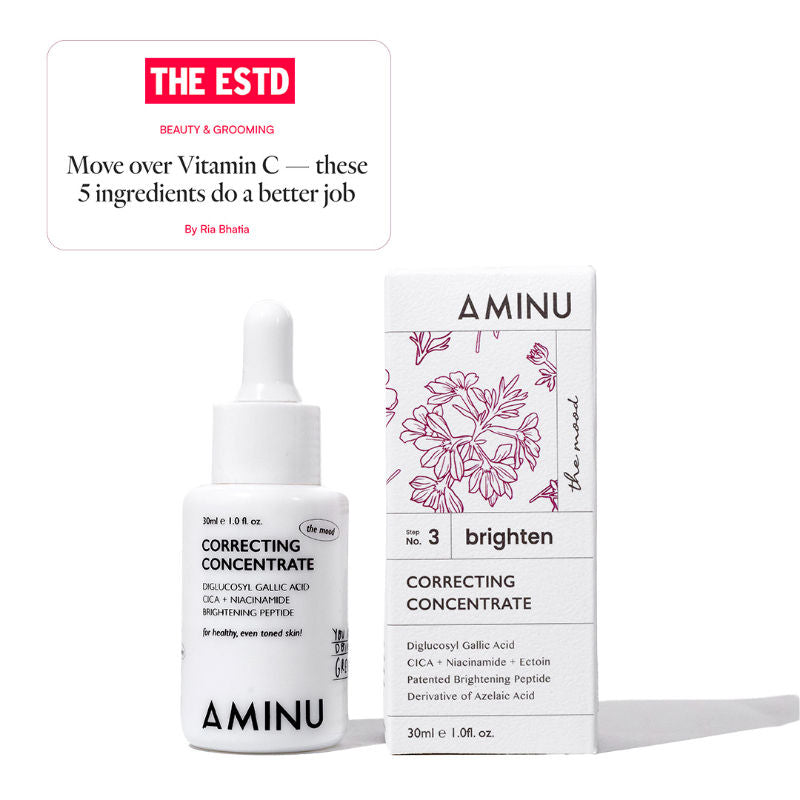
Aminu Correcting Concentrate (10 ml)

Aminu Correcting Concentrate (10 ml)
Nykaa E retail limited
aminu-correcting-concentrate-10-ml
Serum
10084788240677
Morning or Evening?
How often will you use this product?
Notes


Highlights
WHAT IS IT?
Correcting Concentrate with 28 ingredients
FEATURES
Contains Rose Hydrosol, Diglucosyl Gallic Acid, Niacinamide, amino-acid complex, mushroom extracts; targets pigmentation and uneven skin tone
BEST FOR
sensitive
CHECKS
Does not contain harmful preservatives except food grade preservatives Sodium Benzoate and Potassium Sorbate
Who Is It For?
Adults All GendersWhat Does It Help With?
Pigmentation Uneven Skin Tone Skin BrighteningBudget
Mid-range ($30-$75)How To Use
Which routine should it be used in?
Instructions:
Key Information

What Nykaa E retail limited Says
Product Description:
Explore the entire range of Serums & Essence available on Nykaa. Shop more Aminu products here. You can browse through the complete world of Aminu Serums & Essence.
About the Brand:
Ingredients Overview
Ingredients List
Rose-Hydrosol,Diglucosyl-Gallic-Acid,Niacinamide,Methylpropanediol,Propanediol,Psidium-Guajava-Leaf-Extract,Saccharomyces-Lysate-Extract,Lysine,Histidine,Arginine,Aspartic-acid,Threonine,Serine,Glutamic-acid,Proline,Glycine,Alanine,Valine,Methionine,Isoleucine,Leucine,Tyrosine,Phenylalanine,Cysteine,Caviar-Lime-Fruit-Extract,Sodium-Benzoate,Potassium-Sorbate,Broussonetia-Kazinoki-Root-Extract,Acetyl-Glucosamine,Mullberry-Extract,Apple-Fruit-Extract,Camellia-Leaf-Extract,Green-Tea-Leaf-Extract,Centella-Asiatica-Extract,Galactoarabinan,Pine-Mushroom-Extract,Ergosterol,Hydroxyphenoxy-Propionic-Acid,Trisodium-Ethylenediamine-Disuccinate,Xanthan-Gum,Hydroxypropyl-Starch-Phosphate,Caprylyl-Glycol,Phenylpropanol,Mica,Tin-Oxide,Titanium-Dioxide,Hydrolyzed-Sodium-Hyaluronate
Key Ingredients
Rose Hydrosol, Diglucosyl Gallic Acid, Niacinamide, Acetyl Glucosamine, Centella Asiatica Extract
Ingredients Details
Alanine
Common Name(s): L-alanine,2-aminopropanoic acid
CAS Number: 56-41-7
DESCRIPTION
What It Does: Provides nmf-type humectant moisture retention and skin conditioning.
Why It's Used: Simple, well-tolerated nmf amino acid humectant for skin conditioning formulations.
How It Works: Small methyl side chain contributes to protein hydrophobic core but as free amino acid provides direct humectant activity via amino and carboxyl groups. converted to pyruvate for cellular atp production via gluconeogenesis.
Typically Found In: Nmf moisturizers,skin conditioning products
TECHNICAL DETAILS
Primary Category: Active ingredient – amino acid
Secondary Functions: Nmf component,cellular energy
Application Areas:

Facial Skincare

Body Care
Hair Care
Beard Care
Color Cosmetics (Makeup)
Dietary/Oral Supplements
Typical Concentration Range: 0.5%–5%
SOURCING & ETHICS
Vegan Status: Conditional - feedstock declaration required
Halal Status: Unverified - feedstock declaration required (plant, animal and petrochemical routes all exist)
Source Notes: Fermentation-derived or synthetic. natural skin component. [audit 2026-07-29 rev2: origin-dependent: the same inci exists in plant, animal and petrochemical versions and the name does not discriminate. determination requires shariah-panel sign-off.]
SKIN COMPATIBILITY
Irritancy Rating: 1/5 – very low
Comedogenicity Rating: 0/5 – non-comedogenic
Sensitivity Concerns: Non-irritating; endogenous skin molecule.
Safe for Sensitive Skin: Yes
SAFETY & COMPATIBILITY
Safety Profile: Excellent safety profile. natural skin nmf component. ewg score: 1.
Works Well With: Hyaluronic acid,ceramides,peptides,other amino acids
Avoid Combining With: No significant incompatibilities
SCIENTIFIC NOTE
Free alanine is among the most abundant amino acids in the stratum corneum nmf, where it contributes to the aqueous phase hydration that keeps the stratum corneum flexible and functional.
Last Verified: 2026-03-12
Primary Sources: Cosing database,cir safety assessment
Arginine
Common Name(s): L-arginine,2-amino-5-guanidinopentanoic acid
CAS Number: 74-79-3
DESCRIPTION
What It Does: Conditions skin, attracts moisture, supports wound healing, and improves microcirculation via no synthesis.
Why It's Used: Multi-functional amino acid for skin hydration, conditioning, and wound healing in peptide and nmf formulations.
How It Works: Guanidinium group binds water (humectant). substrate for nitric oxide synthase (enos) producing nitric oxide that vasodilates capillaries improving skin nutrition. stimulates fibroblast proliferation for wound healing.
Typically Found In: Anti-aging serums,wound healing products,nmf moisturizers,scalp treatments
TECHNICAL DETAILS
Primary Category: Active ingredient – amino acid
Secondary Functions: Wound healing,microcirculation,nmf component
Application Areas:
Facial Skincare
Body Care
Hair Care
Beard Care
Color Cosmetics (Makeup)
Dietary/Oral Supplements
Typical Concentration Range: 0.5%–5%
SOURCING & ETHICS
Vegan Status: Conditional - feedstock declaration required
Halal Status: Unverified - feedstock declaration required (plant, animal and petrochemical routes all exist)
Source Notes: Fermentation-derived or synthetic. natural skin component. [audit 2026-07-29 rev2: origin-dependent: the same inci exists in plant, animal and petrochemical versions and the name does not discriminate. determination requires shariah-panel sign-off.]
SKIN COMPATIBILITY
Irritancy Rating: 1/5 – very low
Comedogenicity Rating: 0/5 – non-comedogenic
Sensitivity Concerns: Non-irritating; endogenous skin molecule.
Safe for Sensitive Skin: Yes
SAFETY & COMPATIBILITY
Safety Profile: Excellent safety profile. natural skin nmf component. ewg score: 1.
Works Well With: Hyaluronic acid,ceramides,peptides,other amino acids
Avoid Combining With: No significant incompatibilities
SCIENTIFIC NOTE
Arginine is a conditionally essential amino acid in wound healing where local demand exceeds synthesis capacity. topical arginine provides the nos substrate locally for no-mediated vasodilation and immune cell function in healing tissue.
Last Verified: 2026-03-12
Primary Sources: Cosing database,cir safety assessment,witte & barbul arginine wound healing review
Cysteine
Common Name(s): L-cysteine,2-amino-3-mercaptopropanoic acid
CAS Number: 52-90-4
DESCRIPTION
What It Does: Provides sulfur for keratin disulfide bonds, supports glutathione antioxidant synthesis, and directly scavenges free radicals.
Why It's Used: Hair strengthening via keratin disulfide bond support and antioxidant defense as a glutathione precursor.
How It Works: Thiol group (-sh) forms disulfide bonds (-s-s-) between adjacent keratin chains providing mechanical strength to hair and nails. glutathione synthase uses cysteine as the rate-limiting substrate for the master antioxidant glutathione.
Typically Found In: Hair strengthening treatments,keratin products,antioxidant formulations
TECHNICAL DETAILS
Primary Category: Active ingredient – amino acid
Secondary Functions: Keratin disulfide bond,glutathione precursor
Application Areas:
Facial Skincare
Body Care
Hair Care
Beard Care
Color Cosmetics (Makeup)
Dietary/Oral Supplements
Typical Concentration Range: 0.1%–2%
SOURCING & ETHICS
Vegan Status: Conditional - feedstock declaration required
Halal Status: Unverified - feedstock declaration required (plant, animal and petrochemical routes all exist)
Source Notes: Fermentation-derived or synthetic. natural skin component. [audit 2026-07-29 rev2: origin-dependent: the same inci exists in plant, animal and petrochemical versions and the name does not discriminate. determination requires shariah-panel sign-off.]
SKIN COMPATIBILITY
Irritancy Rating: 1/5 – very low
Comedogenicity Rating: 0/5 – non-comedogenic
Sensitivity Concerns: Non-irritating; endogenous skin molecule.
Safe for Sensitive Skin: Yes
SAFETY & COMPATIBILITY
Safety Profile: Excellent safety profile. natural skin nmf component. ewg score: 1.
Works Well With: Hyaluronic acid,ceramides,peptides,other amino acids
Avoid Combining With: No significant incompatibilities
SCIENTIFIC NOTE
Hair's mechanical strength (tensile and torsional) is primarily determined by the density of disulfide crosslinks between adjacent keratin alpha-helices. chemical treatments (bleaching, perming) break these bonds; cysteine topical application may support their restoration.
Last Verified:
Ergosterol
Common Name(s): Ergosterol,ergosterol,fungal provitamin d2,uv-activated skin-conditioning sterol
CAS Number: N/a
DESCRIPTION
What It Does: Provides sc-compatible sterol emolliency analogous to cholesterol for barrier integration, and uv-activation to vitamin d2 (ergocalciferol) — the plant/fungal equivalent of the skin's uvb-driven vitamin d3 synthesis.
Why It's Used: Ergosterol's uv-activation to vitamin d2 mirrors cholecalciferol synthesis from 7-dehydrocholesterol — both undergo [1,7]-sigmatropic photoisomerisation upon uvb exposure, providing photoactivated vitamin d from entirely different precursors.
How It Works: Uv-b photoisomerisation of ergosterol: ergosterol → pre-vitamin d2 (uvb 295-310 nm, [1,7]-sigmatropic rearrangement of the b-ring) → ergocalciferol (thermal isomerisation) → skin vdr activation. sc sterol: the ergostane ring geometry integrates into sc lamellar bilayers providing cholesterol-analogous barrier fluidity.
Typically Found In: Skin conditioning,vitamin d support
TECHNICAL DETAILS
Primary Category: Functional ingredient – emollient
Secondary Functions: Barrier sealing,softening
Application Areas:
Facial Skincare
Body Care
Hair Care
Beard Care
Color Cosmetics (Makeup)
Dietary/Oral Supplements
Typical Concentration Range: 0.1%–3%
SOURCING & ETHICS
Vegan Status: Conditional - supplier confirmation required
Halal Status: Unverified - supplier confirmation required
Source Notes: Plant-derived, synthetic or animal-derived. verify source. [audit 2026-07-29 rev2: the record's own source_notes does not assert a non-animal origin, or instructs the reader to verify with the supplier; "yes" asserts knowledge the record does not hold. determination requires shariah-panel sign-off.]
SKIN COMPATIBILITY
Irritancy Rating: 1/5 – very low
Comedogenicity Rating: 1/5 – low; formulation-dependent
Sensitivity Concerns: Non-irritating.
Safe for Sensitive Skin: Yes
SAFETY & COMPATIBILITY
Safety Profile: Excellent safety profile. ewg score: 1.
Works Well With: Humectants,ceramides,actives as carrier
Avoid Combining With: No significant incompatibilities
SCIENTIFIC NOTE
Ergosterol vs cholesterol in sc: ergosterol has an additional double bond (c22-c23) making the ring system slightly less flexible than cholesterol — the formulator should test barrier integration performance for each application as the chain-length difference may affect lamellar phase behaviour.
Last Verified: 2026-03-22
Primary Sources: Cosing database,ergosterol fungal provitamin d2 sc sterol review