

The Face Shop
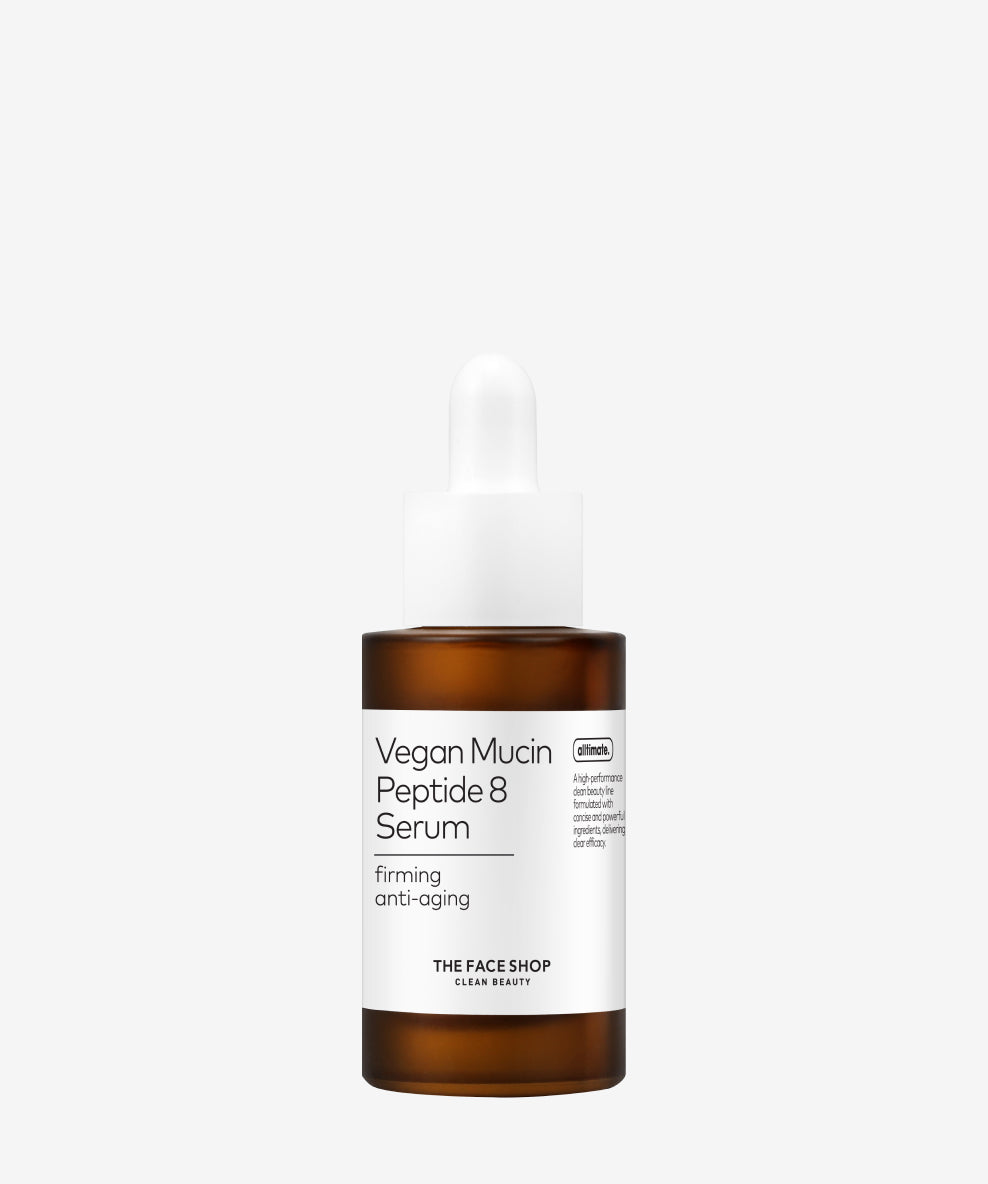
Alltimate Vegan Mucin Peptide 8 Serum

Alltimate Vegan Mucin Peptide 8 Serum
The Face Shop
alltimate-vegan-mucin-peptide-8-serum
Serum
9706818666789
Morning or Evening?
How often will you use this product?
Notes


Highlights
WHAT IS IT?
Vegan mucin serum with 8 peptides
FEATURES
Fast-absorbing, plant-powered, fragrance-free, dermatologically tested
BEST FOR
Normal, Combination, Oily, Sensitive skin types
CHECKS
Free of pigment, alcohol, paraben, artificial fragrances, mineral oil, benzophenone
Who Is It For?
Above 18 Women And MenWhat Does It Help With?
Dryness Loss Of Firmness And Elasticity Fine Lines And WrinklesBudget
AffordableHow To Use
Which routine should it be used in?
Instructions:
Key Information


What The Face Shop Says
Product Description:
The new generation of snail mucin is here, and it's more powerful than ever. Except this time, no snails. Our Alltimate plant-powered Mucin is packed by fast-acting complex of ingredients. With similar great benefits that Snail Mucin offer, our Vegan mucin derived from wild yam root has a secret: It's incredibly fast. Quick absorption means bouncier, firmer, and glassier-looking skin within seconds.
About the Brand:
Ingredients Overview
Ingredients List
WATER/EAU, GLYCERIN, NIACINAMIDE, POLYGLYCERIN-3, BUTYLENE GLYCOL, 1,2-HEXANEDIOL, PANTHENOL, ADENOSINE, Dioscorea Opposita (wild Yam) Root Extract, GLUTATHIONE, ARGININE/LYSINE POLYPEPTIDE, ACETYL TETRAPEPTIDE-9, ACETYL HEXAPEPTIDE-8, OLIGOPEPTIDE-107 SH-OLIGOPEPTIDE-1, COPPER TRIPEPTIDE-1, PALMITOYL TRIPEPTIDE-1, PALMITOYL TETRAPEPTIDE-7, ALLANTOIN, UNDECANE, TRIDECANE, GLYCINE, DESAMIDO COLLAGEN, SERINE, ARGININE, SODIUM POLYACRYLATE, CARBOMER, GLYCERYL ACRYLATE/ACRYLIC ACID COPOLYMER, POLYGLYCERYL-10 STEARATE, POLYGLYCERYL-10 OLEATE, CITRIC ACID, CHOLESTEROL, HYDROGENATED LECITHIN, PEG-8 CAPRYLIC/CAPRIC GLYCERIDES, POLYSORBATE 20, TOCOPHEROL, SODIUM LACTATE, SORBIC ACID, TROMETHAMINE, CAPRYLYL GLYCOL, ALCOHOL DENAT.
Key Ingredients
Wild Yam Root Extract, 8-Peptide Complex, Glutathione
Ingredients Details
12 Hexanediol
Common Name(s): 12 hexanediol
DESCRIPTION
What It Does: Delivers targeted skin-conditioning or bioactive benefits through a specific mechanism of action suited to the formulation's intended purpose.
Why It's Used: Specialty actives address specific skin concerns through targeted molecular mechanisms, providing efficacy beyond what base formulation ingredients alone can achieve.
How It Works: The bioactive compound interacts with specific molecular targets in skin cells or the extracellular matrix — enzymes, receptors, structural proteins, or signaling molecules — triggering beneficial biological responses.
Typically Found In: Serums,treatments,moisturizers,specialty products
TECHNICAL DETAILS
Primary Category: Specialty actives
Secondary Functions: Skin-conditioning,anti-aging
Application Areas:

Facial Skincare

Body Care
Hair Care
Beard Care
Color Cosmetics (Makeup)
Dietary/Oral Supplements
Typical Concentration Range: 0.01–5%
SOURCING & ETHICS
Vegan Status: Conditional - supplier confirmation required
Halal Status: Unverified - supplier confirmation required
Source Notes: Specialty active ingredient; check individual sourcing for vegan status. [audit 2026-07-29 rev2: the record's own source_notes does not assert a non-animal origin, or instructs the reader to verify with the supplier; "yes" asserts knowledge the record does not hold. determination requires shariah-panel sign-off.]
SKIN COMPATIBILITY
Irritancy Rating: 1899-12-31 00:00:00 -0800
Sensitivity Concerns: Low sensitization potential at recommended use concentrations.
Safe for Sensitive Skin: Yes
SAFETY & COMPATIBILITY
Safety Profile: Well-characterized cosmetic ingredient with established safety profile. generally non-irritating at typical use concentrations. suitable for leave-on and rinse-off cosmetics.
Works Well With: Niacinamide,hyaluronic acid,vitamin c,peptides
Avoid Combining With: Incompatible with oxidizing agents; check ph stability
SCIENTIFIC NOTE
Specialty actives typically work through enzyme inhibition (e.g., tyrosinase inhibition for brightening, mmp inhibition for anti-aging), receptor activation (e.g., retinoid receptors, ppar-γ for barrier genes), or transcription factor modulation (e.g., nrf2 for antioxidant gene upregulation). structure-activity relationships determine potency and selectivity.
Last Verified: 2025-01-15
Primary Sources: Cosing eu database; pcpc cosmetic ingredient safety reviews; ingredient-specific safety and efficacy literature
Adenosine
Common Name(s): Adenine riboside,9-beta-d-ribofuranosyladenine
CAS Number: 58-61-7
DESCRIPTION
What It Does: Reduces fine lines, stimulates collagen, firms skin, and reduces inflammation.
Why It's Used: Fda-recognized anti-wrinkle active with multi-action collagen stimulation + wrinkle reduction + anti-inflammatory efficacy.
How It Works: Activates adenosine a2a receptors on fibroblasts stimulating collagen type i. also activates pka pathway promoting atp production and reducing inflammatory cytokines.
Typically Found In: Anti-aging serums,wrinkle treatments,korean skincare
TECHNICAL DETAILS
Primary Category: Active ingredient – purine nucleoside / anti-aging
Secondary Functions: Collagen stimulation,anti-inflammatory,cell energy
Application Areas:
Facial Skincare
Body Care
Hair Care
Beard Care
Color Cosmetics (Makeup)
Dietary/Oral Supplements
Typical Concentration Range: 0.04%–0.1%
SOURCING & ETHICS
Vegan Status: Conditional - supplier confirmation required
Halal Status: Unverified - supplier confirmation required
Source Notes: Synthetically produced for cosmetic use. [audit 2026-07-29 rev2: status downgraded on audit. determination requires shariah-panel sign-off.]
SKIN COMPATIBILITY
Irritancy Rating: 1/5 – very low
Comedogenicity Rating: 0/5 – non-comedogenic
Sensitivity Concerns: Non-irritating; excellent tolerability.
Safe for Sensitive Skin: Yes
SAFETY & COMPATIBILITY
Safety Profile: Excellent safety profile. fda-recognized as safe and effective anti-wrinkle ingredient. ewg score: 1.
Works Well With: Other b vitamins,niacinamide,antioxidant complexes
Avoid Combining With: No significant incompatibilities
SCIENTIFIC NOTE
A 2002 clinical study demonstrated 0.04% adenosine cream significantly reduced wrinkle depth and increased skin elasticity after 4 weeks. fda recognition requires controlled clinical trial evidence.
Last Verified: 2026-03-12
Primary Sources: Cosing database,adenosine anti-aging clinical data,fda otc anti-wrinkle monograph
Butylene Glycol
Common Name(s): 1,3-butanediol,bg,1,3-butylene glycol
CAS Number: 107-88-0
DESCRIPTION
What It Does: Provides humectant hydration and active ingredient solubilization with excellent skin feel.
Why It's Used: Preferred glycol humectant in premium and k-beauty formulations for superior skin feel vs propylene glycol with equivalent functionality.
How It Works: Two hydroxyl groups at 1,3-positions provide water binding and solvent activity. better tolerated than propylene glycol with minimal sensitization risk. 4-carbon backbone provides slightly greater hydrophobic character enabling dissolution of less polar actives vs pg.
Typically Found In: Toners,essences,serums,k-beauty formulas
TECHNICAL DETAILS
Primary Category: Functional ingredient – glycol humectant
Secondary Functions: Tewl reduction,skin plumping
Application Areas:
Facial Skincare
Body Care
Hair Care
Beard Care
Color Cosmetics (Makeup)
Dietary/Oral Supplements
Typical Concentration Range: 1%–10%
SOURCING & ETHICS
Vegan Status: Yes – synthetic
Halal Status: Yes
Source Notes: Synthetic or naturally derived. excellent aqueous solubility.
SKIN COMPATIBILITY
Irritancy Rating: 1/5 – very low
Comedogenicity Rating: 0/5 – non-comedogenic
Sensitivity Concerns: Non-irritating; suitable for all skin types.
Safe for Sensitive Skin: Yes
SAFETY & COMPATIBILITY
Safety Profile: Excellent safety profile. ewg score: 1.
Works Well With: Ceramides,emollients,occlusives,glycerin,hyaluronic acid
Avoid Combining With: No significant incompatibilities
SCIENTIFIC NOTE
K-beauty's preference for butylene glycol over propylene glycol is driven by two factors: bg's superior skin feel (less tacky than pg's higher viscosity) and its lower sensitization potential (1,3-bg has better spatial distribution of hydroxyl groups that reduces protein interaction vs pg's 1,2-position oh groups).
Last Verified: 2026-03-12
Primary Sources: Cosing database,cir safety assessment
Glutathione
Common Name(s): Gsh,gamma-l-glutamyl-l-cysteinyl-glycine,reduced glutathione
CAS Number: 70-18-8
DESCRIPTION
What It Does: Provides the body's primary antioxidant defense while reducing melanin production for brightening.
Why It's Used: Master antioxidant for comprehensive oxidative stress protection alongside unique melanin-shifting brightening action (pheomelanin preference).
How It Works: Three-amino acid tripeptide (gamma-glu-cys-gly). thiol group (-sh) provides electron donation for antioxidant activity and detoxification conjugation. shifts melanin synthesis from eumelanin (dark brown) toward pheomelanin (light yellow-red) for brightening. regenerates vitamins c and e from their oxidized forms.
Typically Found In: Brightening serums,antioxidant serums,anti-aging products
TECHNICAL DETAILS
Primary Category: Active ingredient – master cellular antioxidant
Secondary Functions: Melanin shifting brightening,vitamins c+e regeneration,master antioxidant
Application Areas:
Facial Skincare
Body Care
Hair Care
Beard Care
Color Cosmetics (Makeup)
Dietary/Oral Supplements
Typical Concentration Range: 0.1%–5%
SOURCING & ETHICS
Vegan Status: Conditional - supplier confirmation required
Halal Status: Unverified - supplier confirmation required
Source Notes: Produced by yeast fermentation or chemical synthesis. stability challenge – use encapsulated or stabilized forms. [audit 2026-07-29 rev2: status downgraded on audit. determination requires shariah-panel sign-off.]
SKIN COMPATIBILITY
Irritancy Rating: 1/5 – very low
Comedogenicity Rating: 0/5 – non-comedogenic
Sensitivity Concerns: Well-tolerated; some reports of tingling at high concentrations.
Safe for Sensitive Skin: Yes
SAFETY & COMPATIBILITY
Safety Profile: Excellent safety profile. ewg score: 1.
Works Well With: Vitamin c,vitamin e,ferulic acid,spf,other antioxidants
Avoid Combining With: No significant incompatibilities
SCIENTIFIC NOTE
Glutathione's melanin-shifting mechanism (eumelanin→pheomelanin) is entirely different from tyrosinase inhibition. even in the presence of active tyrosinase, glutathione shifts the enzymatic product from dark eumelanin to lighter pheomelanin by chelating copper from the tyrosinase active site and competing for dopa substrate.
Last Verified: 2026-03-12
Primary Sources: Cosing database,villarama & maibach glutathione brightening review,cir safety assessment