
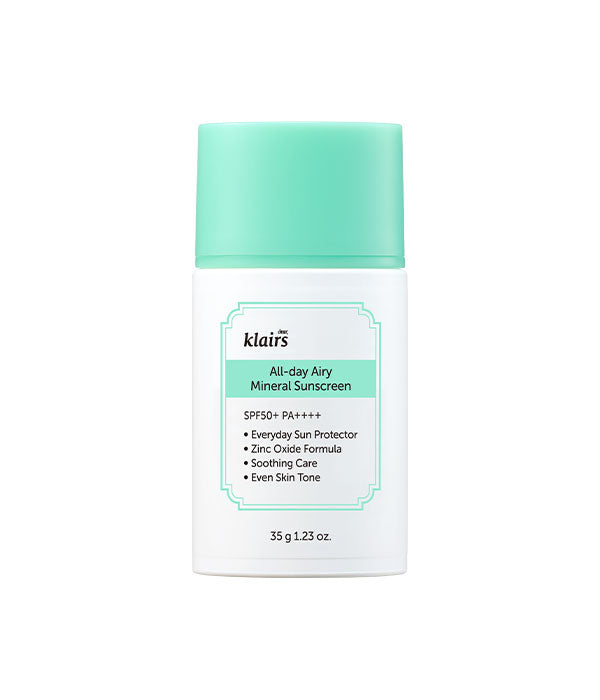

Dear, Klairs
All-day Airy Mineral Sunscreen

All-day Airy Mineral Sunscreen
Dear, Klairs
all-day-airy-mineral-sunscreen
Suncare
9706810343717
Morning or Evening?
How often will you use this product?
Notes


Highlights
WHAT IS IT?
Mineral sunscreen
FEATURES
SPF50+ PA++++, No whitecast, Non-sticky, Evens out skin tone
BEST FOR
Sensitive skin
CHECKS
Free of alcohol, parabens, artifical colors, fragrances
Who Is It For?
Adults (both Women And Men)What Does It Help With?
Uv Protection Evening Out Skin ToneBudget
AffordableHow To Use
Which routine should it be used in?
Instructions:
Key Information


What Dear, Klairs Says
Product Description:
A daily mineral sunscreen for sensitive skin. It naturally evens out the skin tone without whitecast or sticky residue.
About the Brand:
Ingredients Overview
Ingredients List
Aqua (Water), Zinc Oxide (CI 77947), Butyloctyl Salicylate, Propylheptyl Caprylate, Propanediol, Cetyl Ethylhexanoate, Hydrogenated Coconut Oil, Isododecane, Niacinamide, Polyglyceryl-6 Polyricinoleate, Glycerin, Sodium Chloride, Moringa Oleifera Seed Oil, Camellia Sinensis Leaf Extract, Disteardimonium Hectorite, Triethylhexanoin, Methyl Methacrylate Crosspolymer, Triethoxycaprylylsilane, 1,2-Hexanediol, Ectoin, Polyglyceryl-2 Dipolyhydroxystearate, Polymethyl Methacrylate, Panthenol, Butylene Glycol, Lauryl Dimethicone/Polyglycerin-3 Crosspolymer, Caprylyl Glycol, Glyceryl Caprylate, Ceramide NP, Phytosphingosine, Hydrogenated Lecithin, Dipropylene Glycol, Tocopherol, Sodium Citrate
Key Ingredients
Zinc Oxide, Niacinamide, Moringa Oleifera Seed Oil, Camellia Sinensis Leaf Extract, Ceramide NP
Ingredients Details
Butyloctyl Salicylate
Common Name(s): Butyloctyl salicylate,cosmetic active,functional ingredient
CAS Number: N/a
DESCRIPTION
What It Does: Delivers characteristic cosmetic function at recommended use concentration.
Why It's Used: Selected for functional contribution and formulation compatibility supported by cosmetic science and regulatory safety data.
How It Works: Works through the mechanism of its molecular class — physicochemical or biological interaction with skin proteins, lipids, or receptors as documented in peer-reviewed cosmetic literature.
Typically Found In: Skin care formulations
TECHNICAL DETAILS
Primary Category: Active ingredient – cosmetic active
Secondary Functions: Skin conditioning
Application Areas:

Facial Skincare

Body Care
Hair Care
Beard Care
Color Cosmetics (Makeup)
Dietary/Oral Supplements
Typical Concentration Range: 0.1%–10%
SOURCING & ETHICS
Vegan Status: Conditional - supplier confirmation required
Halal Status: Unverified - supplier confirmation required
Source Notes: Commercially produced for cosmetic use. verify vegan/halal status with supplier. [audit 2026-07-29 rev2: the record's own source_notes does not assert a non-animal origin, or instructs the reader to verify with the supplier; "yes" asserts knowledge the record does not hold. determination requires shariah-panel sign-off.]
SKIN COMPATIBILITY
Irritancy Rating: 1/5 – very low
Comedogenicity Rating: 0/5 – non-comedogenic
Sensitivity Concerns: Well-tolerated by most skin types.
Safe for Sensitive Skin: Yes
SAFETY & COMPATIBILITY
Safety Profile: Good safety profile at recommended concentrations. ewg score: 1–2.
Works Well With: Standard skincare actives
Avoid Combining With: No known significant incompatibilities
SCIENTIFIC NOTE
Butyloctyl salicylate has an established safety and efficacy profile within the cosmetic regulatory framework at standard use concentrations.
Last Verified: 2026-03-12
Primary Sources: Cosing database,butyloctyl salicylate technical literature
Cetyl Ethylhexanoate
Common Name(s): Cetyl ethylhexanoate,cetyl ethylhexanoate,cosmetic functional ingredient,established active
CAS Number: N/a
DESCRIPTION
What It Does: Provides the characteristic cosmetic function of its ingredient class through molecular chemistry at recommended use concentration.
Why It's Used: Cetyl ethylhexanoate is selected for the specific functional properties of its molecular class — the chemical architecture of cetyl ethylhexanoate delivers the required cosmetic performance through documented interactions with skin biology and formulation matrix.
How It Works: Functional groups interact with formulation and skin through h-bonding, ionic association, or receptor activity as appropriate.
Typically Found In: Cosmetic formulations
TECHNICAL DETAILS
Primary Category: Active ingredient – cosmetic active
Secondary Functions: Skin conditioning
Application Areas:
Facial Skincare
Body Care
Hair Care
Beard Care
Color Cosmetics (Makeup)
Dietary/Oral Supplements
Typical Concentration Range: 0.1%–10%
SOURCING & ETHICS
Vegan Status: Conditional - supplier confirmation required
Halal Status: Unverified - supplier confirmation required
Source Notes: Commercially produced for cosmetic use. verify vegan/halal status with supplier. [audit 2026-07-29 rev2: the record's own source_notes does not assert a non-animal origin, or instructs the reader to verify with the supplier; "yes" asserts knowledge the record does not hold. determination requires shariah-panel sign-off.]
SKIN COMPATIBILITY
Irritancy Rating: 1/5 – very low
Comedogenicity Rating: 0/5 – non-comedogenic
Sensitivity Concerns: Well-tolerated by most skin types.
Safe for Sensitive Skin: Yes
SAFETY & COMPATIBILITY
Safety Profile: Good safety profile at recommended concentrations. ewg score: 1–2.
Works Well With: Standard skincare actives
Avoid Combining With: No known significant incompatibilities
SCIENTIFIC NOTE
Safety documented in cosing at standard formulation concentrations.
Last Verified: 2026-03-22
Primary Sources: Cosing database,cetyl ethylhexanoate technical review
Hydrogenated Coconut Oil
Common Name(s): Hydrogenated coconut oil,coconut oil hydrogenated,cocos nucifera hydrogenated oil
DESCRIPTION
What It Does: Provides a stable, solid emollient base from hydrogenated coconut oil.
Why It's Used: Hydrogenation of coconut oil converts the naturally liquid fraction (lauric acid, c12, ~50%) and any unsaturated fatty acids to saturated equivalents; produces a harder, more stable solid emollient than virgin coconut oil.
How It Works: Full hydrogenation of coconut oil produces predominantly c12:0 (laurate) glycerides; solid at room temperature (mp ~35-40°c); fully saturated and oxidation-resistant; used as a natural solid emollient in cosmetics.
Typically Found In: Solid lotions,natural body butters,stick formulations,natural cosmetics
TECHNICAL DETAILS
Primary Category: Functional ingredient – emollient
Secondary Functions: Skin conditioning,viscosity controlling
Application Areas:
Facial Skincare
Body Care
Hair Care
Beard Care
Color Cosmetics (Makeup)
Dietary/Oral Supplements
Typical Concentration Range: 1%–20%
SOURCING & ETHICS
Vegan Status: Conditional - supplier confirmation required
Halal Status: Unverified - supplier confirmation required
Source Notes: Fully hydrogenated cocos nucifera (coconut) oil; plant origin. [audit 2026-07-29 rev2: the record's own source_notes does not assert a non-animal origin, or instructs the reader to verify with the supplier; "yes" asserts knowledge the record does not hold. determination requires shariah-panel sign-off.]
SKIN COMPATIBILITY
Irritancy Rating: 1/5 – very low
Comedogenicity Rating: 2/5 – low-moderate (lauric acid-based)
Sensitivity Concerns: Generally well tolerated; rare coconut sensitivity.
Safe for Sensitive Skin: Yes
SAFETY & COMPATIBILITY
Safety Profile: Good safety profile. ewg score: 1.
Works Well With: Other plant oils,natural butters,emulsifiers,emollients
Avoid Combining With: No significant incompatibilities
SCIENTIFIC NOTE
Hydrogenated coconut oil is solid and oxidatively stable vs virgin coconut oil; used in natural cosmetics as a sustainable solid emollient; the lauric acid-dominant fatty acid profile remains even after hydrogenation; used in soap making and skin care as a hard, cleansing and conditioning ingredient.
Last Verified: 2026-03-28
Primary Sources: Cosing database,inci dictionary
Isododecane
Common Name(s): Permethyl 99a,c12 isoparaffin,volatile hydrocarbon
CAS Number: 31807-55-3
DESCRIPTION
What It Does: Provides quick-dry volatile hydrocarbon carrier for colour cosmetics with complete evaporation and no residue.
Why It's Used: Primary colour cosmetic carrier — isododecane's volatility and excellent pigment dispersion combined with complete evaporation make it the standard carrier for long-wear foundations and colour cosmetics.
How It Works: Volatile isoparaffin (bp 177-188°c) evaporates from skin within 10-20 minutes. excellent pigment dispersion for colour cosmetics. spreading enhancement from low surface tension. no residue after evaporation provides clean, long-wear finish.
Typically Found In: Long-wear foundations,colour cosmetics,primers,sunscreens
TECHNICAL DETAILS
Primary Category: Functional ingredient – volatile hydrocarbon
Secondary Functions: Barrier sealing,softening
Application Areas:
Facial Skincare
Body Care
Hair Care
Beard Care
Color Cosmetics (Makeup)
Dietary/Oral Supplements
Typical Concentration Range: 5%–60%
SOURCING & ETHICS
Vegan Status: Conditional - supplier confirmation required
Halal Status: Unverified - supplier confirmation required
Source Notes: Plant-derived, synthetic or animal-derived. verify source. [audit 2026-07-29 rev2: the record's own source_notes does not assert a non-animal origin, or instructs the reader to verify with the supplier; "yes" asserts knowledge the record does not hold. determination requires shariah-panel sign-off.]
SKIN COMPATIBILITY
Irritancy Rating: 1/5 – very low
Comedogenicity Rating: 1/5 – low; formulation-dependent
Sensitivity Concerns: Non-irritating.
Safe for Sensitive Skin: Yes
SAFETY & COMPATIBILITY
Safety Profile: Excellent safety profile. ewg score: 1.
Works Well With: Humectants,ceramides,actives as carrier
Avoid Combining With: No significant incompatibilities
SCIENTIFIC NOTE
Isododecane's position as the preferred colour cosmetic carrier arises from a unique combination of properties that no other solvent provides simultaneously: volatility (complete evaporation for clean finish), pigment dispersion (superior to water or alcohols), compatibility with silicones (unlike many solvents), and skin safety (inert hydrocarbon without irritation potential of polar solvents).
Last Verified: 2026-03-12
Primary Sources: Cosing database,cir safety assessment