

AIKEN
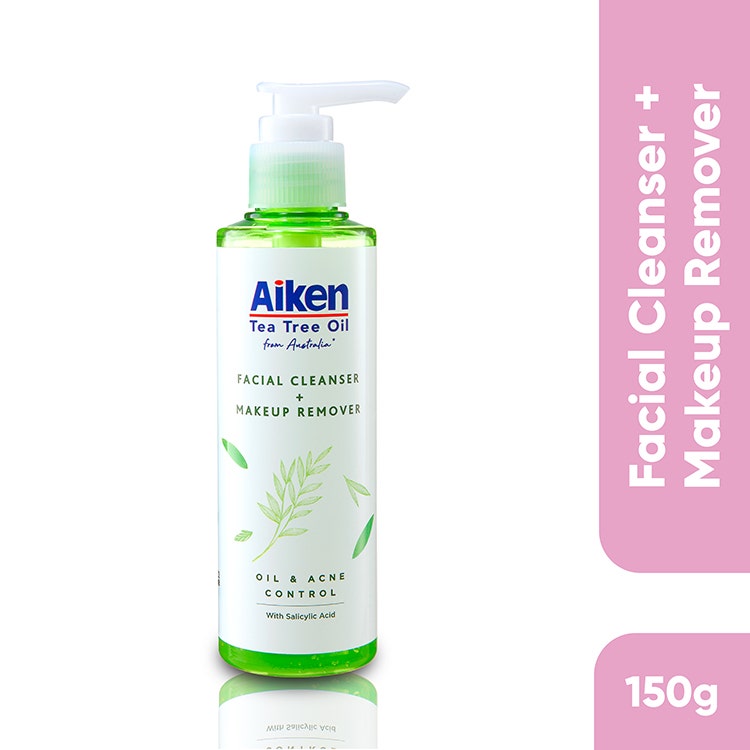
Aiken Tto Facial Cleanser+Makeup Remover 150Ml

Aiken Tto Facial Cleanser+Makeup Remover 150Ml
AIKEN
aiken-tto-facial-cleanser-makeup-remover-150ml
Cleanse
10084777885989
Morning or Evening?
How often will you use this product?
Notes


Highlights
WHAT IS IT?
2 in 1 gel-based cleanser and makeup remover
FEATURES
Contains Tea Tree Oil, gel-based with beads, effectively cleanses and removes makeup, mild ingredients, prevents blemish and blackheads, controls oil, gentle for daily use, hydrates and keeps skin pimple free
BEST FOR
oily
CHECKS
Not explicitly stated but mild ingredients imply free from harsh chemicals
Who Is It For?
What Does It Help With?
Pimples Blemishes Blackheads Oily SkinBudget
Affordable (under $30)How To Use
Which routine should it be used in?
Instructions:
Key Information


What AIKEN Says
Product Description:
Contains Tea Tree Oil (Melaleuca Alternifolia) to helps protect skin from pimples naturally. An effective 2 in 1 gel-based cleanser & make up remover with beads for effective cleansing and removing trace of make up. Formulated with mild ingredients to keep skin clear, helps to prevent blemish and blackheads while controlling oil. Gentle enough for daily use. Regular use helps keep skin healthy hydrating and pimple free.
About the Brand:
Ingredients Overview
Ingredients List
Water, Ammonium Lauryl Sulfate, Acrylates Copolymer, Glycerin, Coco-Betaine, Sodium Methyl Cocoyl Taurate, Sodium Cocoyl Isethionate, PEG-7 Glyceryl Cocoate, Sodium Lauroyl Sarcosinate, C12-15 Pareth-12, Melaleuca Alternifolia (Tea Tree) Leaf Oil, Mannitol, Cellulose, Hydroxypropyl Methylcellulose, Jojoba Esters, Tocopheryl Acetate, Ascorbyl Palmitate, Benzophenone-4, Methyl Methacrylate Crosspolymer, Fragrance, Sodium Hydroxide, Tetrasodium EDTA, Phenoxyethanol, Chlorphenesin, Ci 77492
Key Ingredients
Tea Tree Oil
Ingredients Details
Acrylates Copolymer
Common Name(s): Acrylic copolymer,carbopol ez,flexible film former
CAS Number: 25133-97-5
DESCRIPTION
What It Does: Provides versatile acrylic film formation and thickening across broad ph range.
Why It's Used: Versatile workhorse polymer for film formation and thickening across diverse cosmetic product types from acidic aha serums to alkaline cleansers.
How It Works: Copolymer of acrylic acid and methacrylic acid esters. thickens via polymer chain entanglement and electrostatic repulsion. film formation from chain entanglement on water evaporation. broad ph stability from balanced acid/neutral monomer composition.
Typically Found In: Serums,lotions,sunscreens — versatile across formulation types
TECHNICAL DETAILS
Primary Category: Functional ingredient – acrylic film former
Secondary Functions: Skin conditioning
Application Areas:

Facial Skincare

Body Care
Hair Care
Beard Care
Color Cosmetics (Makeup)
Dietary/Oral Supplements
Typical Concentration Range: 0.1%–3%
SOURCING & ETHICS
Vegan Status: Yes – synthetic
Halal Status: Yes
Source Notes: Commercially produced for cosmetic use. verify vegan/halal status with supplier.
SKIN COMPATIBILITY
Irritancy Rating: 1/5 – very low
Comedogenicity Rating: 0/5 – non-comedogenic
Sensitivity Concerns: Well-tolerated by most skin types.
Safe for Sensitive Skin: Yes
SAFETY & COMPATIBILITY
Safety Profile: Good safety profile at recommended concentrations. ewg score: 1–2.
Works Well With: Standard skincare actives
Avoid Combining With: No known significant incompatibilities
SCIENTIFIC NOTE
Acrylates copolymers' broad ph thickening stability (vs carbomer's ph-sensitive thickening, requiring neutralisation for viscosity) enables thickening of acidic aha serums (ph 3-4) without neutralisation — maintaining the low ph required for aha efficacy while providing viscosity control. this acid-stable thickening is impossible with conventional carbomers.
Last Verified: Cosing database,cir safety assessment
Primary Sources: 2026-03-12
Ammonium Lauryl Sulfate
Common Name(s): Ammonium lauryl sulfate,cosmetic active,functional ingredient
CAS Number: N/a
DESCRIPTION
What It Does: Delivers characteristic cosmetic function at recommended use concentration.
Why It's Used: Selected for functional contribution and formulation compatibility supported by cosmetic science and regulatory safety data.
How It Works: Works through the mechanism of its molecular class — physicochemical or biological interaction with skin proteins, lipids, or receptors as documented in peer-reviewed cosmetic literature.
Typically Found In: Skin care formulations
TECHNICAL DETAILS
Primary Category: Active ingredient – cosmetic active
Secondary Functions: Skin conditioning
Application Areas:
Facial Skincare
Body Care
Hair Care
Beard Care
Color Cosmetics (Makeup)
Dietary/Oral Supplements
Typical Concentration Range: 0.1%–10%
SOURCING & ETHICS
Vegan Status: Conditional
Halal Status: Yes
Source Notes: Commercially produced for cosmetic use. verify vegan/halal status with supplier.
SKIN COMPATIBILITY
Irritancy Rating: 1/5 – very low
Comedogenicity Rating: 0/5 – non-comedogenic
Sensitivity Concerns: Well-tolerated by most skin types.
Safe for Sensitive Skin: Yes
SAFETY & COMPATIBILITY
Safety Profile: Good safety profile at recommended concentrations. ewg score: 1–2.
Works Well With: Standard skincare actives
Avoid Combining With: No known significant incompatibilities
SCIENTIFIC NOTE
Ammonium lauryl sulfate has an established safety and efficacy profile within the cosmetic regulatory framework at standard use concentrations.
Last Verified: Cosing database,ammonium lauryl sulfate technical literature
Primary Sources: 2026-03-12
Ascorbyl Palmitate
Common Name(s): L-ascorbyl-6-palmitate,vitamin c palmitate,fat-soluble vitamin c
CAS Number: 137-66-6
DESCRIPTION
What It Does: Provides lipid-soluble antioxidant protection in skin and oil-based formulations.
Why It's Used: Oil-based formulations as fat-soluble vitamin c active and formulation antioxidant preservative (e304).
How It Works: Skin esterases cleave the bond releasing ascorbic acid and palmitic acid. lipophilic form may integrate into cell membranes for lipid-phase antioxidant protection.
Typically Found In: Oil serums,emulsions,sunscreens,anti-aging creams
TECHNICAL DETAILS
Primary Category: Active ingredient – vitamin c derivative
Secondary Functions: Lipid-soluble antioxidant,formulation preservative
Application Areas:
Facial Skincare
Body Care
Hair Care
Beard Care
Color Cosmetics (Makeup)
Dietary/Oral Supplements
Typical Concentration Range: 0.1%–1%
SOURCING & ETHICS
Vegan Status: Yes – synthetic
Halal Status: Yes
Source Notes: Esterification of ascorbic acid with palmitic acid. gras food additive (e304).
SKIN COMPATIBILITY
Irritancy Rating: 1/5 – very low
Comedogenicity Rating: 1/5 – very low; palmitic acid minor concern
Sensitivity Concerns: Non-irritating; suitable for all skin types.
Safe for Sensitive Skin: Yes
SAFETY & COMPATIBILITY
Safety Profile: Excellent safety profile. ewg score: 1.
Works Well With: Tocopherol,ferulic acid,niacinamide,spf
Avoid Combining With: No significant incompatibilities
SCIENTIFIC NOTE
Debate exists about efficiency of ester hydrolysis in intact skin and prooxidant potential of uv degradation products. formulating with the antioxidant triad (c+e+ferulic) mitigates this concern.
Last Verified: Cosing database,cir safety assessment,ewg skin deep
Primary Sources: 2026-03-12
Benzophenone-4
Common Name(s): Benzophenone-4
DESCRIPTION
What It Does: Absorbs or reflects uv radiation, preventing uv-induced dna damage, photo-oxidative stress, and premature skin aging.
Why It's Used: Uv filters are the active ingredients in sun protection — without them, formulations cannot make spf claims or prevent solar-induced skin damage.
How It Works: The uv-absorbing chromophore undergoes photoexcitation by uv photons, then dissipates the absorbed energy through thermal relaxation (chemical filters) or photon scattering/reflection (physical filters), preventing photon penetration to skin cells.
Typically Found In: Sunscreens,moisturizers with spf,foundations with spf
TECHNICAL DETAILS
Primary Category: Uv filters
Secondary Functions: Skin-protecting
Application Areas:
Facial Skincare
Body Care
Hair Care
Beard Care
Color Cosmetics (Makeup)
Dietary/Oral Supplements
Typical Concentration Range: 0.5–25% (within regulatory limits)
SOURCING & ETHICS
Vegan Status: Yes
Halal Status: Yes
Source Notes: Synthetic uv filter; no animal components.
SKIN COMPATIBILITY
Irritancy Rating: 1
Comedogenicity Rating: 0
Sensitivity Concerns: Contact allergy to uv filters occurs in approximately 1–3% of the general population; patch testing recommended for those with known photosensitivity.
Safe for Sensitive Skin: Yes
SAFETY & COMPATIBILITY
Safety Profile: Regulatory approval required per market (eu annex vi, fda otc monograph, etc.). generally non-irritating at approved concentrations.
Works Well With: Other uv filters,antioxidants,emollients
Avoid Combining With: Incompatible filter combinations (photodegradation); check regulatory approvals per region
SCIENTIFIC NOTE
Uv filters operate through two mechanisms: organic/chemical filters absorb uv photons through electronic excitation (π→π* transitions in conjugated systems), then dissipate energy via thermal relaxation; inorganic/physical filters (tio2, zno) scatter and reflect photons through mie scattering (particle size 50–300 nm) and band gap absorption. spf is measured in vivo (iso 24444) as the ratio of minimal erythema doses with and without sunscreen.
Last Verified: Cosing eu database; pcpc cosmetic ingredient safety reviews; eu cosmetics regulation annex vi; iso 24444 (in vivo spf testing)
Primary Sources: 2025-01-15
