

AIKEN
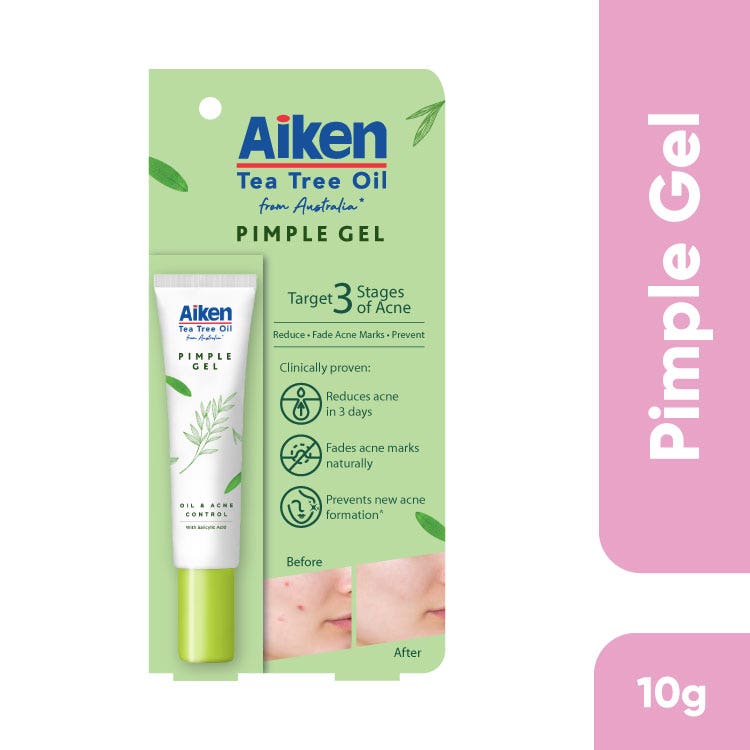
Aiken Tea Tree Oil Pimple Gel 10G

Aiken Tea Tree Oil Pimple Gel 10G
AIKEN
aiken-tea-tree-oil-pimple-gel-10g
Serum
10084760813861
Morning or Evening?
How often will you use this product?
Notes


Highlights
WHAT IS IT?
Pimple gel with multiple active ingredients
FEATURES
Enriched with tea tree oil and salicylic acid, clinically proven to reduce acne in 3 days, helps prevent new acne formation, targets acne reduction, fades acne marks
BEST FOR
oily
CHECKS
Does not contain parabens, sulfates, alcohol; gentle on skin without leaving scars
Who Is It For?
For All Genders Suitable For Acne-prone SkinWhat Does It Help With?
Acne Reduction Acne Marks Fading Sebum Control Prevention Of New AcneBudget
Affordable (under $30)How To Use
Which routine should it be used in?
Instructions:
Key Information


What AIKEN Says
Product Description:
Aiken Tea Tree Oil Pimple Gel enriched with tea tree oil and salicylic acid (BHA) clinically proven to reduce acne in 3 days, proven to control acne and gentle on skin without leaving scars, helps to prevent new acne formation, target 3 stages of acne to reduce acne, fade acne marks and prevent new acne formation for visibly healthy and acne-free skin.
About the Brand:
Ingredients Overview
Ingredients List
Water, Panthenol, Lactic Acid, Butylene Glycol, Aminomethyl Propanol, Salicylic Acid, Methylpropanediol, Xanthan Gum, 3-O-Ethyl Ascorbic Acid, Dextrin, Polydextrose, Glycerin, Amylopectin, Niacinamide, Dimethicone, Lecithin, Sclerotium Gum, Pullulan, Melaleuca Alternifolia (Tea Tree) Leaf Oil, Ethylhexylglycerin, Disodium EDTA, Asiaticoside, Madecassic Acid, Asiatic Acid, Melia Azadirachta (Neem) Leaf Extract, Octocrylene, Mandelic Acid, Phenoxyethanol, Sodium Metabisulfite
Key Ingredients
Tea Tree Oil, Salicylic Acid, Niacinamide, Panthenol
Ingredients Details
3-o-ethyl Ascorbic Acid
Common Name(s): 3-o-ethyl ascorbic acid
DESCRIPTION
What It Does: Loosens corneocyte adhesion in the stratum corneum, accelerating cell turnover, refining skin texture, and improving radiance.
Why It's Used: Organic acids at cosmetic ph values provide controlled keratolytic exfoliation that improves skin texture, pore appearance, and radiance without mechanical irritation.
How It Works: At appropriate ph, the acid's undissociated form penetrates the stratum corneum and dissolves the ionic bonds between corneocyte desmosomes (calcium chelation mechanism), facilitating controlled desquamation and cell renewal.
Typically Found In: Toners,exfoliants,serums,peels,cleansers
TECHNICAL DETAILS
Primary Category: Exfoliants
Secondary Functions: Brightening,keratolytic
Application Areas:

Facial Skincare

Body Care
Hair Care
Beard Care
Color Cosmetics (Makeup)
Dietary/Oral Supplements
Typical Concentration Range: 0.5–20%
SOURCING & ETHICS
Vegan Status: Yes
Halal Status: Yes
Source Notes: Synthetic or plant-derived acid; no animal components.
SKIN COMPATIBILITY
Irritancy Rating: 2
Comedogenicity Rating: 0
Sensitivity Concerns: May cause irritation or stinging in sensitive or barrier-compromised skin at high concentrations; patch test recommended.
Safe for Sensitive Skin: Conditional
SAFETY & COMPATIBILITY
Safety Profile: Safe within recommended ph and concentration ranges. sensitization risk increases above 10% aha. patch test recommended for sensitive skin. mildly irritating to some individuals at typical cosmetic use concentrations.
Works Well With: Niacinamide,hyaluronic acid,ceramides,vitamin c
Avoid Combining With: High concentrations on sensitive/broken skin; avoid with physical exfoliants
SCIENTIFIC NOTE
Cosmetic acids function at the pka boundary: only the undissociated acid (rcooh) penetrates the stratum corneum lipid barrier, while the ionized carboxylate (rcoo⁻) does not. the henderson-hasselbalch equation governs the fraction of active species at formulation ph; typically 0.5–3.0% undissociated acid provides efficacy while minimizing irritation.
Last Verified: 2025-01-15
Primary Sources: Cosing eu database; pcpc cosmetic ingredient safety reviews; ingredient-specific safety and efficacy literature
Aminomethyl Propanol
Common Name(s): Aminomethyl propanol,cosmetic active,functional ingredient
CAS Number: N/a
DESCRIPTION
What It Does: Delivers characteristic cosmetic function at recommended use concentration.
Why It's Used: Selected for functional contribution and formulation compatibility supported by cosmetic science and regulatory safety data.
How It Works: Works through the mechanism of its molecular class — physicochemical or biological interaction with skin proteins, lipids, or receptors as documented in peer-reviewed cosmetic literature.
Typically Found In: Skin care formulations
TECHNICAL DETAILS
Primary Category: Active ingredient – cosmetic active
Secondary Functions: Skin conditioning
Application Areas:
Facial Skincare
Body Care
Hair Care
Beard Care
Color Cosmetics (Makeup)
Dietary/Oral Supplements
Typical Concentration Range: 0.1%–10%
SOURCING & ETHICS
Vegan Status: Conditional - supplier confirmation required
Halal Status: Unverified - supplier confirmation required
Source Notes: Commercially produced for cosmetic use. verify vegan/halal status with supplier. [audit 2026-07-29 rev2: the record's own source_notes does not assert a non-animal origin, or instructs the reader to verify with the supplier; "yes" asserts knowledge the record does not hold. determination requires shariah-panel sign-off.]
SKIN COMPATIBILITY
Irritancy Rating: 1/5 – very low
Comedogenicity Rating: 0/5 – non-comedogenic
Sensitivity Concerns: Well-tolerated by most skin types.
Safe for Sensitive Skin: Yes
SAFETY & COMPATIBILITY
Safety Profile: Good safety profile at recommended concentrations. ewg score: 1–2.
Works Well With: Standard skincare actives
Avoid Combining With: No known significant incompatibilities
SCIENTIFIC NOTE
Aminomethyl propanol has an established safety and efficacy profile within the cosmetic regulatory framework at standard use concentrations.
Last Verified: 2026-03-12
Primary Sources: Cosing database,aminomethyl propanol technical literature
Amylopectin
Common Name(s): Amylopectin,cosmetic active,functional ingredient
CAS Number: N/a
DESCRIPTION
What It Does: Delivers characteristic cosmetic function at recommended use concentration.
Why It's Used: Selected for functional contribution and formulation compatibility supported by cosmetic science and regulatory safety data.
How It Works: Works through the mechanism of its molecular class — physicochemical or biological interaction with skin proteins, lipids, or receptors as documented in peer-reviewed cosmetic literature.
Typically Found In: Skin care formulations
TECHNICAL DETAILS
Primary Category: Active ingredient – cosmetic active
Secondary Functions: Skin conditioning
Application Areas:
Facial Skincare
Body Care
Hair Care
Beard Care
Color Cosmetics (Makeup)
Dietary/Oral Supplements
Typical Concentration Range: 0.1%–10%
SOURCING & ETHICS
Vegan Status: Conditional - supplier confirmation required
Halal Status: Unverified - supplier confirmation required
Source Notes: Commercially produced for cosmetic use. verify vegan/halal status with supplier. [audit 2026-07-29 rev2: the record's own source_notes does not assert a non-animal origin, or instructs the reader to verify with the supplier; "yes" asserts knowledge the record does not hold. determination requires shariah-panel sign-off.]
SKIN COMPATIBILITY
Irritancy Rating: 1/5 – very low
Comedogenicity Rating: 0/5 – non-comedogenic
Sensitivity Concerns: Well-tolerated by most skin types.
Safe for Sensitive Skin: Yes
SAFETY & COMPATIBILITY
Safety Profile: Good safety profile at recommended concentrations. ewg score: 1–2.
Works Well With: Standard skincare actives
Avoid Combining With: No known significant incompatibilities
SCIENTIFIC NOTE
Amylopectin has an established safety and efficacy profile within the cosmetic regulatory framework at standard use concentrations.
Last Verified: 2026-03-12
Primary Sources: Cosing database,amylopectin technical literature
Asiatic Acid
Common Name(s): Brahmic acid,centella active
CAS Number: 464-92-6
DESCRIPTION
What It Does: Stimulates normal wound healing collagen synthesis while preventing excessive fibrosis and hypertrophic scar formation.
Why It's Used: Unique anti-fibrotic wound healing ingredient – stimulates collagen i and iii while reducing excessive tgf-β-driven fibrosis, making it ideal for preventing hypertrophic scars.
How It Works: Stimulates col1a1/col3a1 transcription in normal fibroblasts while inhibiting tgf-β-induced myofibroblast differentiation that drives hypertrophic scar formation. also inhibits nf-kb for anti-inflammatory activity.
Typically Found In: Scar prevention products,post-procedure recovery,wound healing
TECHNICAL DETAILS
Primary Category: Active ingredient – soothing / anti-inflammatory
Secondary Functions: Anti-fibrotic,scar prevention,collagen regulation
Application Areas:
Facial Skincare
Body Care
Hair Care
Beard Care
Color Cosmetics (Makeup)
Dietary/Oral Supplements
Typical Concentration Range: 0.01%–1%
SOURCING & ETHICS
Vegan Status: Yes – from centella asiatica
Halal Status: Yes
Source Notes: Plant-derived extract or synthetic.
SKIN COMPATIBILITY
Irritancy Rating: 1/5 – very low
Comedogenicity Rating: 0/5 – non-comedogenic
Sensitivity Concerns: Non-irritating; ideal for reactive and sensitive skin.
Safe for Sensitive Skin: Yes – particularly recommended for sensitive skin
SAFETY & COMPATIBILITY
Safety Profile: Excellent safety profile. ewg score: 1.
Works Well With: Ceramides,panthenol,allantoin,hyaluronic acid,centella asiatica
Avoid Combining With: No significant incompatibilities
SCIENTIFIC NOTE
The paradox of asiatic acid is its ability to both stimulate collagen synthesis (anti-aging) and prevent fibrosis (anti-scarring) from the same compound. this selective effect occurs because asiatic acid stimulates normal fibroblast collagen synthesis while specifically inhibiting tgf-β1-driven myofibroblast transformation – the cell type responsible for excessive scar tissue.
Last Verified: 2026-03-12
Primary Sources: Cosing database,maquart et al. asiatic acid study