
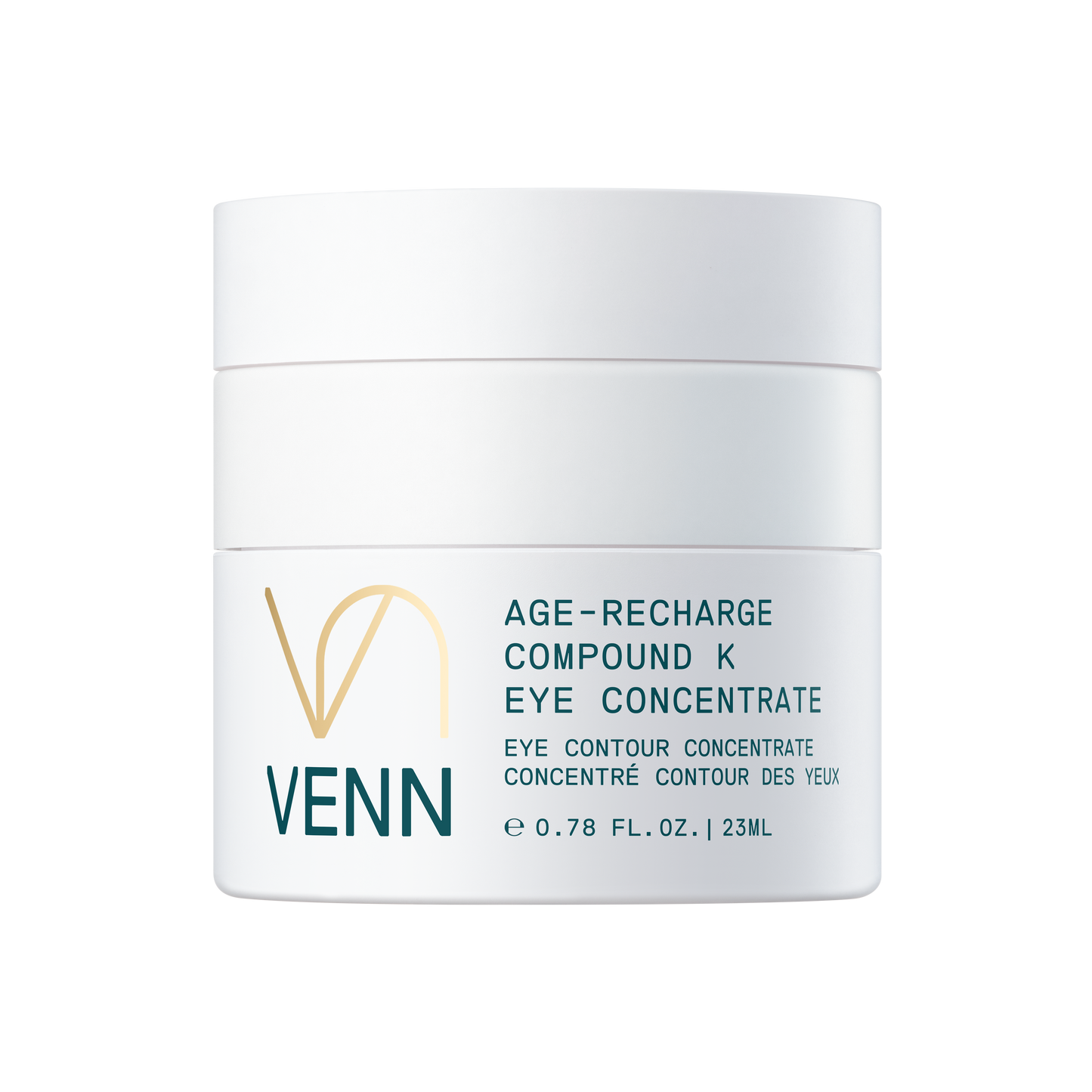

VENN SKINCARE
Age-Recharge Compound K Eye Concentrate

Age-Recharge Compound K Eye Concentrate
VENN SKINCARE
age-recharge-compound-k-eye-concentrate
Eyecare
9706799628581
Morning or Evening?
How often will you use this product?
Notes


Highlights
WHAT IS IT?
Eye cream with multiple active ingredients
FEATURES
Fast-absorbing, anti-aging, targets multiple eye area concerns
BEST FOR
suitable for those with eye area concerns
CHECKS
Free of synthetic fragrance, parabens, silicones, phthalates
Who Is It For?
Adults (default Above 18) Both Women And MenWhat Does It Help With?
Crow's Feet Wrinkles Dark Circles Under-eye Puffiness Elasticity Around The Eye AreaBudget
PremiumHow To Use
Which routine should it be used in?
Instructions:
Key Information


What VENN SKINCARE Says
Product Description:
Fast-absorbing, anti-aging eye cream, supercharged with innovative actives specifically developed to target eye area concerns, including the appearance of crow's feet and wrinkles, the look of dark circles, the under-eye puffiness (eye bags), and the elasticity around the eye area.
About the Brand:
Ingredients Overview
Ingredients List
Houttuynia Cordata Water, Water, Butylene Glycol, Glycerin, C13-15 Alkane, Cetearyl Olivate, Sorbitan Olivate, Cocoglycerides, Squalane, Helianthus Annuus (Sunflower) Seed Oil, 1,2-Hexanediol, Hydrogenated Lecithin, Bakuchiol, Glyceryl Stearate, Panthenol, Bacillus Ferment, Saccharomyces Ferment, Galactomyces Ferment Filtrate, Lactobacillus Ferment, Ginsenosides, Cetyl Palmitate, Sorbitan Palmitate, Hydrogenated Olive Oil, Cetearyl Alcohol, Shea Butter Glycerides, Behenic Acid, Butyrospermum Parkii (Shea) Butter, Propanediol, Olea Europaea (Olive) Fruit Oil, Caprylic/Capric Triglyceride, Hydrolyzed Extensin, Hydrolyzed Glycosaminoglycans, Sodium Hyaluronate, Ceramide NP, Dipotassium Glycyrrhizate, Macadamia Ternifolia Seed Oil, Stearic Acid, Arginine, Behenyl Alcohol, Stearyl Alcohol, Glutathione, Carbomer, Camellia Sinensis Leaf Water, Lupinus Albus Seed Extract, Xanthan Gum, Histidine, Isoleucine, Leucine, Lysine, Methionine, Phenylalanine, Threonine, Valine, Alanine, Tyrosine, Glycine, Proline, Cysteine, Carnosine, Serine, Beta-Glucan, Illicium Verum (Anise) Fruit Extract, Olea Europaea (Olive) Oil Unsaponifiables, Adenosine, Myristic Acid, Glutamic Acid, Cholesterol, Polyglyceryl-10 Laurate, Aspartic Acid, Scutellaria Baicalensis Root Extract, Brassica Campestris (Rapeseed) Sterols, Polyglyceryl-3 Methylglucose Distearate, Retinal, Acetyl Tetrapeptide-5, Acetyl Hexapeptide-8, Palmitoyl Tripeptide-5, Palmitoyl Tetrapeptide-7, Palmitoyl Tripeptide-1, Silica, Gentiana Lutea Root Extract, Tocopherol, Aluminum/Magnesium Hydroxide Stearate, Potassium Cetyl Phosphate, Pentaerythrityl Tetra-di-t-butyl Hydroxyhydrocinnamate, Cyclodextrin
Key Ingredients
Ginsenoside Compound K, Bakuchiol (1%), Retinal Liposome (2%), 5 Clinical Grade Peptides, MYRALYS (0.5%), Hydrolyzed Extensin (1%), 17 Amino Acids
Ingredients Details
Butylene Glycol
Common Name(s): 1,3-butanediol,bg,1,3-butylene glycol
CAS Number: 107-88-0
DESCRIPTION
What It Does: Provides humectant hydration and active ingredient solubilization with excellent skin feel.
Why It's Used: Preferred glycol humectant in premium and k-beauty formulations for superior skin feel vs propylene glycol with equivalent functionality.
How It Works: Two hydroxyl groups at 1,3-positions provide water binding and solvent activity. better tolerated than propylene glycol with minimal sensitization risk. 4-carbon backbone provides slightly greater hydrophobic character enabling dissolution of less polar actives vs pg.
Typically Found In: Toners,essences,serums,k-beauty formulas
TECHNICAL DETAILS
Primary Category: Functional ingredient – glycol humectant
Secondary Functions: Tewl reduction,skin plumping
Application Areas:

Facial Skincare
Body Care
Hair Care

Beard Care
Color Cosmetics (Makeup)
Dietary/Oral Supplements
Typical Concentration Range: 1%–10%
SOURCING & ETHICS
Vegan Status: Yes – synthetic
Halal Status: Yes
Source Notes: Synthetic or naturally derived. excellent aqueous solubility.
SKIN COMPATIBILITY
Irritancy Rating: 1/5 – very low
Comedogenicity Rating: 0/5 – non-comedogenic
Sensitivity Concerns: Non-irritating; suitable for all skin types.
Safe for Sensitive Skin: Yes
SAFETY & COMPATIBILITY
Safety Profile: Excellent safety profile. ewg score: 1.
Works Well With: Ceramides,emollients,occlusives,glycerin,hyaluronic acid
Avoid Combining With: No significant incompatibilities
SCIENTIFIC NOTE
K-beauty's preference for butylene glycol over propylene glycol is driven by two factors: bg's superior skin feel (less tacky than pg's higher viscosity) and its lower sensitization potential (1,3-bg has better spatial distribution of hydroxyl groups that reduces protein interaction vs pg's 1,2-position oh groups).
Last Verified: 2026-03-12
Primary Sources: Cosing database,cir safety assessment
C13-15 Alkane
Common Name(s): C13-15 alkane,cosmetic active,functional ingredient
CAS Number: N/a
DESCRIPTION
What It Does: Delivers characteristic cosmetic function at recommended use concentration.
Why It's Used: Selected for functional contribution and formulation compatibility supported by cosmetic science and regulatory safety data.
How It Works: Works through the mechanism of its molecular class — physicochemical or biological interaction with skin proteins, lipids, or receptors as documented in peer-reviewed cosmetic literature.
Typically Found In: Skin care formulations
TECHNICAL DETAILS
Primary Category: Active ingredient – cosmetic active
Secondary Functions: Skin conditioning
Application Areas:
Facial Skincare
Body Care
Hair Care
Beard Care
Color Cosmetics (Makeup)
Dietary/Oral Supplements
Typical Concentration Range: 0.1%–10%
SOURCING & ETHICS
Vegan Status: Conditional - supplier confirmation required
Halal Status: Unverified - supplier confirmation required
Source Notes: Commercially produced for cosmetic use. verify vegan/halal status with supplier. [audit 2026-07-29 rev2: the record's own source_notes does not assert a non-animal origin, or instructs the reader to verify with the supplier; "yes" asserts knowledge the record does not hold. determination requires shariah-panel sign-off.]
SKIN COMPATIBILITY
Irritancy Rating: 1/5 – very low
Comedogenicity Rating: 0/5 – non-comedogenic
Sensitivity Concerns: Well-tolerated by most skin types.
Safe for Sensitive Skin: Yes
SAFETY & COMPATIBILITY
Safety Profile: Good safety profile at recommended concentrations. ewg score: 1–2.
Works Well With: Standard skincare actives
Avoid Combining With: No known significant incompatibilities
SCIENTIFIC NOTE
C13-15 alkane has an established safety and efficacy profile within the cosmetic regulatory framework at standard use concentrations.
Last Verified: 2026-03-12
Primary Sources: Cosing database,c13-15 alkane technical literature
Cetearyl Olivate
Common Name(s): Nonionic emulsifier,o/w surfactant,emulsion stabiliser
CAS Number: N/a
DESCRIPTION
What It Does: Stabilises o/w emulsions by forming a molecular monolayer at the oil-water interface, provides co-emulsification synergy with other emulsifiers, and contributes to emulsion texture through interfacial film properties.
Why It's Used: Nonionic emulsifiers are preferred for sensitive skin and ph-extreme formulations — no ionic charge means no electrostatic interaction with skin proteins, no ph-dependent function loss, and compatibility with both anionic and cationic co-ingredients.
How It Works: Hlb determines emulsion type: hlb 8–12 for o/w emulsification; hlb 3–6 for w/o. the peg or glycoside head group provides hydrophilicity while the c16–c18 fatty chain provides lipophilicity. at the o/w interface, nonionic emulsifiers form a mixed monolayer reducing interfacial tension from ~35 mn/m (clean oil-water) to 5–10 mn/m, providing thermodynamic stabilisation.
Typically Found In: Creams,lotions,o/w emulsions
TECHNICAL DETAILS
Primary Category: Active ingredient – cosmetic active
Secondary Functions: Skin conditioning
Application Areas:
Facial Skincare
Body Care
Hair Care
Beard Care
Color Cosmetics (Makeup)
Dietary/Oral Supplements
Typical Concentration Range: 1%–10%
SOURCING & ETHICS
Vegan Status: Conditional - supplier confirmation required
Halal Status: Unverified - supplier confirmation required
Source Notes: Commercially produced for cosmetic use. verify vegan/halal status with supplier. [audit 2026-07-29 rev2: the record's own source_notes does not assert a non-animal origin, or instructs the reader to verify with the supplier; "yes" asserts knowledge the record does not hold. determination requires shariah-panel sign-off.]
SKIN COMPATIBILITY
Irritancy Rating: 1/5 – very low
Comedogenicity Rating: 0/5 – non-comedogenic
Sensitivity Concerns: Well-tolerated by most skin types.
Safe for Sensitive Skin: Yes
SAFETY & COMPATIBILITY
Safety Profile: Good safety profile at recommended concentrations. ewg score: 1–2.
Works Well With: Standard skincare actives
Avoid Combining With: No known significant incompatibilities
SCIENTIFIC NOTE
Mixed emulsifier systems (e.g., glyceryl stearate + peg-100 stearate, or cetearyl glucoside + cetearyl alcohol) provide better emulsion stability than single emulsifiers — synergistic packing of different molecular geometries creates a more cohesive, mechanically robust interfacial film.
Last Verified: 2026-03-12
Primary Sources: Cosing database,nonionic emulsifier hlb system review
Cocoglycerides
Common Name(s): Cocoglycerides,cosmetic active,functional ingredient
CAS Number: N/a
DESCRIPTION
What It Does: Delivers characteristic cosmetic function at recommended use concentration.
Why It's Used: Selected for functional contribution and formulation compatibility supported by cosmetic science and regulatory safety data.
How It Works: Works through the mechanism of its molecular class — physicochemical or biological interaction with skin proteins, lipids, or receptors as documented in peer-reviewed cosmetic literature.
Typically Found In: Skin care formulations
TECHNICAL DETAILS
Primary Category: Active ingredient – cosmetic active
Secondary Functions: Skin conditioning
Application Areas:
Facial Skincare
Body Care
Hair Care
Beard Care
Color Cosmetics (Makeup)
Dietary/Oral Supplements
Typical Concentration Range: 0.1%–10%
SOURCING & ETHICS
Vegan Status: Conditional - feedstock declaration required
Halal Status: Unverified - feedstock declaration required (plant, animal and petrochemical routes all exist)
Source Notes: Commercially produced for cosmetic use. verify vegan/halal status with supplier. [audit 2026-07-29 rev2: origin-dependent: the same inci exists in plant, animal and petrochemical versions and the name does not discriminate. determination requires shariah-panel sign-off.]
SKIN COMPATIBILITY
Irritancy Rating: 1/5 – very low
Comedogenicity Rating: 0/5 – non-comedogenic
Sensitivity Concerns: Well-tolerated by most skin types.
Safe for Sensitive Skin: Yes
SAFETY & COMPATIBILITY
Safety Profile: Good safety profile at recommended concentrations. ewg score: 1–2.
Works Well With: Standard skincare actives
Avoid Combining With: No known significant incompatibilities
SCIENTIFIC NOTE
Cocoglycerides has an established safety and efficacy profile within the cosmetic regulatory framework at standard use concentrations.
Last Verified: 2026-03-12
Primary Sources: Cosing database,cocoglycerides technical literature