

Jan Marini
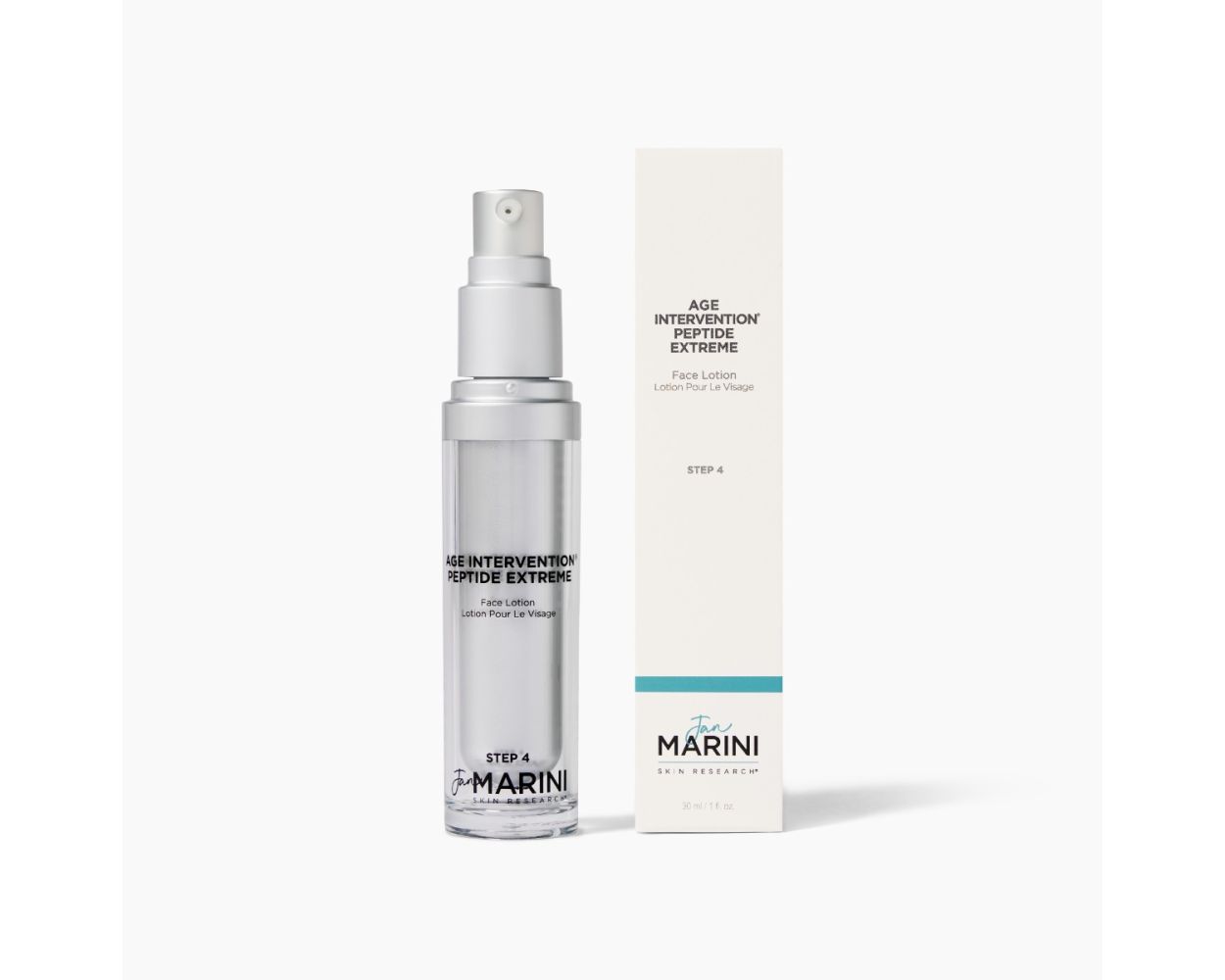
Age Intervention® Peptide Extreme

Age Intervention® Peptide Extreme
Jan Marini
age-intervention-r-peptide-extreme
Moisturize
9706807460133
Morning or Evening?
How often will you use this product?
Notes


Highlights
WHAT IS IT?
Moisturizing lotion with peptides and antioxidants
FEATURES
Lightweight moisturizing lotion to help soothe skin and reduce the visible signs of aging.
BEST FOR
Normal/Combo, Oily skin
CHECKS
Paraben-free
Who Is It For?
Adults (no Specific Age Range Given) Both Women And MenWhat Does It Help With?
Fine Lines And Wrinkles Skin Tone Redness Irritation Signs Of AgingBudget
PremiumHow To Use
Which routine should it be used in?
Instructions:
Key Information


What Jan Marini Says
Product Description:
A concentrated blend of 5 unique peptides are combined with antioxidants and soothing agents including CoEnzyme Q10, green tea, red tea, grape seed and pomegranate extracts to help reduce the appearance of fine lines and wrinkles, improve skin tone and soothe red or irritated skin. This lightweight moisturizing lotion is excellent for daily use or immediately post-procedure to help soothe skin and reduce the visible signs of aging.
About the Brand:
Ingredients Overview
Ingredients List
Water/Aqua/Eau, Glycerin, Helianthus Annuus (Sunflower) Seed Oil, PEG-40 Hydrogenated Castor Oil, Cyclopentasiloxane, Butylene Glycol, Cetearyl Alcohol, Mangifera Indica (Mango) Seed Butter, Limnanthes Alba (Meadowfoam) Seed Oil, Ceteareth-20, Dimethicone, Glyceryl Stearate, Butyrospermum Parkii (Shea) Butter, Panthenol, Methylsilanol Mannuronate, Palmitoyl Tetrapeptide-7, Palmitoyl Tripeptide-1, Myristoyl Pentapeptide-12, Myristoyl Pentapeptide-8, Myristoyl Pentapeptide-11, Ubiquinone, Ceramide NG, Tocopherol, Tocopheryl Acetate, Linoleic Acid, Linolenic Acid, Sodium Hyaluronate, Punica Granatum (Pomegranate) Fruit Extract, Camellia Sinensis Leaf Extract, Aspalathus Linearis Leaf Extract, Vitis Vinifera (Grape) Seed Extract, Allantoin, Dimethicone/Vinyl Dimethicone Crosspolymer, Xanthan Gum, Magnesium Aluminum Silicate, Carbomer, Polysorbate 20, Citric Acid, Caprylyl Glycol, Ethylhexylglycerin, Hexylene Glycol, Quartz, Sodium Lactate, Sorbic Acid, Phenoxyethanol
Key Ingredients
Anti-Aging Peptides, CoEnzyme Q10, Green Tea Extract, Red Tea Extract, Grape Seed Extract, Pomegranate Extract, Meadowfoam Seed Oil, Shea Butter, Mango Seed Butter
Ingredients Details
Butylene Glycol
Common Name(s): 1,3-butanediol,bg,1,3-butylene glycol
CAS Number: 107-88-0
DESCRIPTION
What It Does: Provides humectant hydration and active ingredient solubilization with excellent skin feel.
Why It's Used: Preferred glycol humectant in premium and k-beauty formulations for superior skin feel vs propylene glycol with equivalent functionality.
How It Works: Two hydroxyl groups at 1,3-positions provide water binding and solvent activity. better tolerated than propylene glycol with minimal sensitization risk. 4-carbon backbone provides slightly greater hydrophobic character enabling dissolution of less polar actives vs pg.
Typically Found In: Toners,essences,serums,k-beauty formulas
TECHNICAL DETAILS
Primary Category: Functional ingredient – glycol humectant
Secondary Functions: Tewl reduction,skin plumping
Application Areas:

Facial Skincare
Body Care
Hair Care

Beard Care
Color Cosmetics (Makeup)
Dietary/Oral Supplements
Typical Concentration Range: 1%–10%
SOURCING & ETHICS
Vegan Status: Yes – synthetic
Halal Status: Yes
Source Notes: Synthetic or naturally derived. excellent aqueous solubility.
SKIN COMPATIBILITY
Irritancy Rating: 1/5 – very low
Comedogenicity Rating: 0/5 – non-comedogenic
Sensitivity Concerns: Non-irritating; suitable for all skin types.
Safe for Sensitive Skin: Yes
SAFETY & COMPATIBILITY
Safety Profile: Excellent safety profile. ewg score: 1.
Works Well With: Ceramides,emollients,occlusives,glycerin,hyaluronic acid
Avoid Combining With: No significant incompatibilities
SCIENTIFIC NOTE
K-beauty's preference for butylene glycol over propylene glycol is driven by two factors: bg's superior skin feel (less tacky than pg's higher viscosity) and its lower sensitization potential (1,3-bg has better spatial distribution of hydroxyl groups that reduces protein interaction vs pg's 1,2-position oh groups).
Last Verified: 2026-03-12
Primary Sources: Cosing database,cir safety assessment
Ceteareth-20
Common Name(s): Polyethylene glycol cetearyl ether,peg-20 cetearyl ether
CAS Number: 68439-49-6
DESCRIPTION
What It Does: Provides high-hlb o/w emulsification for stable cream formation from ethoxylated cetearyl alcohol.
Why It's Used: Classic self-emulsifying wax component for standard pharmaceutical and cosmetic cream formulation.
How It Works: 20 eo units on cetearyl alcohol chain provide hlb ~15-17 for strong o/w emulsification. often pre-blended with cetearyl alcohol as 'emulsifying wax' for simplified cream making. combined low-hlb cetearyl alcohol + high-hlb ceteareth-20 forms a balanced self-emulsifying system.
Typically Found In: Classic pharmaceutical and cosmetic creams
TECHNICAL DETAILS
Primary Category: Functional ingredient – ethoxylated fatty alcohol emulsifier
Secondary Functions: Skin conditioning
Application Areas:
Facial Skincare
Body Care
Hair Care
Beard Care
Color Cosmetics (Makeup)
Dietary/Oral Supplements
Typical Concentration Range: 1%–8%
SOURCING & ETHICS
Vegan Status: Conditional - feedstock declaration required
Halal Status: Unverified - feedstock declaration required (plant, animal and petrochemical routes all exist)
Source Notes: Commercially produced for cosmetic use. verify vegan/halal status with supplier. [audit 2026-07-29 rev2: origin-dependent: the same inci exists in plant, animal and petrochemical versions and the name does not discriminate. determination requires shariah-panel sign-off.]
SKIN COMPATIBILITY
Irritancy Rating: 1/5 – very low
Comedogenicity Rating: 0/5 – non-comedogenic
Sensitivity Concerns: Well-tolerated by most skin types.
Safe for Sensitive Skin: Yes
SAFETY & COMPATIBILITY
Safety Profile: Good safety profile at recommended concentrations. ewg score: 1–2.
Works Well With: Standard skincare actives
Avoid Combining With: No known significant incompatibilities
SCIENTIFIC NOTE
Ceteareth-20's combination with cetearyl alcohol in the classic 'emulsifying wax nf' creates what is called a 'mixed emulsifier system' where the fatty alcohol forms lamellar crystal phases that physically trap and stabilize oil droplets. this physical (lamellar crystal) + chemical (hlb balance) dual stabilization provides superior stability compared to either component alone.
Last Verified: 2026-03-12
Primary Sources: Cosing database,cir safety assessment
Cetearyl Alcohol
Common Name(s): Cetostearyl alcohol,c16-18 fatty alcohol
CAS Number: 8005-44-5
DESCRIPTION
What It Does: Provides fatty alcohol emulsification and thickening for stable, well-textured emulsions.
Why It's Used: The most widely used fatty alcohol in cosmetics – provides emulsification, thickening, and emolliency simultaneously from a single ingredient with excellent safety profile.
How It Works: Forms bilayer lamellar structures in water with emulsifiers creating a viscous structured network that thickens and stabilizes emulsions. fatty alcohol emolliency provides direct skin conditioning. bilayer formation reduces inter-droplet coalescence in emulsions.
Typically Found In: Creams,lotions,conditioners – virtually all emulsion products
TECHNICAL DETAILS
Primary Category: Functional ingredient – fatty alcohol emulsifier/thickener
Secondary Functions: Barrier sealing,softening
Application Areas:
Facial Skincare
Body Care
Hair Care
Beard Care
Color Cosmetics (Makeup)
Dietary/Oral Supplements
Typical Concentration Range: 1%–25%
SOURCING & ETHICS
Vegan Status: Yes - standard ethanol routes are non-animal; confirm denaturant origin
Halal Status: Conditional - ethanol production route and residual concentration; jurisdiction-dependent, refer to certifier stance
Source Notes: Plant-derived, synthetic or animal-derived. verify source. [audit 2026-07-29 rev2: ethanol pathway; determination depends on route, on whether the plant also produces beverage alcohol, and on residual concentration. determination requires shariah-panel sign-off.]
SKIN COMPATIBILITY
Irritancy Rating: 1/5 – very low
Comedogenicity Rating: 1/5 – low; formulation-dependent
Sensitivity Concerns: Non-irritating.
Safe for Sensitive Skin: Yes
SAFETY & COMPATIBILITY
Safety Profile: Excellent safety profile. ewg score: 1.
Works Well With: Humectants,ceramides,actives as carrier
Avoid Combining With: No significant incompatibilities
SCIENTIFIC NOTE
Cetearyl alcohol's ability to form lamellar liquid crystal structures ('krafft phases') with water and co-emulsifiers provides not only emulsion stability but also enhanced skin penetration via the lamellar skin barrier pathway. these crystalline structures can act as a reservoir for active ingredients, slowly releasing them as the lamellar structure melts on skin contact.
Last Verified: 2026-03-12
Primary Sources: Cosing database,cir safety assessment
Cyclopentasiloxane
Common Name(s): Cyclopentasiloxane,cyclic volatile silicone,dry-touch carrier solvent
CAS Number: N/a
DESCRIPTION
What It Does: Provides a dry, weightless application vehicle that evaporates cleanly leaving actives and non-volatile silicones deposited on skin — eliminating the residual heaviness of conventional liquid carrier solvents.
Why It's Used: Cyclosiloxanes are the unique volatile silicone solvents that dissolve non-volatile silicones (dimethicone, cyclomethicone), organic uv filters, and lipophilic actives, providing the sensory-superior dry-touch application experience in premium formulations.
How It Works: Cyclosiloxane vapour pressure (d5 cyclopentasiloxane ~0.3 mmhg at 25°c) provides clean evaporation at body temperature. the cyclic ring structure provides lower boiling point than equivalent linear dimethicone, enabling faster evaporation while the ring conformation maintains the silicone's low surface energy for smooth application.
Typically Found In: Primers,antiperspirants,sunscreens
TECHNICAL DETAILS
Primary Category: Functional ingredient – emollient
Secondary Functions: Barrier sealing,softening
Application Areas:
Facial Skincare
Body Care
Hair Care
Beard Care
Color Cosmetics (Makeup)
Dietary/Oral Supplements
Typical Concentration Range: 1%–50%
SOURCING & ETHICS
Vegan Status: Conditional - supplier confirmation required
Halal Status: Unverified - supplier confirmation required
Source Notes: Plant-derived, synthetic or animal-derived. verify source. [audit 2026-07-29 rev2: the record's own source_notes does not assert a non-animal origin, or instructs the reader to verify with the supplier; "yes" asserts knowledge the record does not hold. determination requires shariah-panel sign-off.]
SKIN COMPATIBILITY
Irritancy Rating: 1/5 – very low
Comedogenicity Rating: 1/5 – low; formulation-dependent
Sensitivity Concerns: Non-irritating.
Safe for Sensitive Skin: Yes
SAFETY & COMPATIBILITY
Safety Profile: Excellent safety profile. ewg score: 1.
Works Well With: Humectants,ceramides,actives as carrier
Avoid Combining With: No significant incompatibilities
SCIENTIFIC NOTE
Cyclopentasiloxane (d5) and cyclohexasiloxane (d6) are under eu regulatory review for potential environmental persistence (pbt assessment) — formulators should monitor eu regulation 2018/35 implementation for restrictions in wash-off products.
Last Verified: 2026-03-12
Primary Sources: Cosing database,eu cyclosiloxane regulatory review